ClickBank makes it possible for product owners to sell through an established online commerce platform and potentially recruit affiliates to promote their products.
That sounds like a comparatively straightforward route into online selling. But becoming a ClickBank seller is not the same as having a functioning, profitable business.
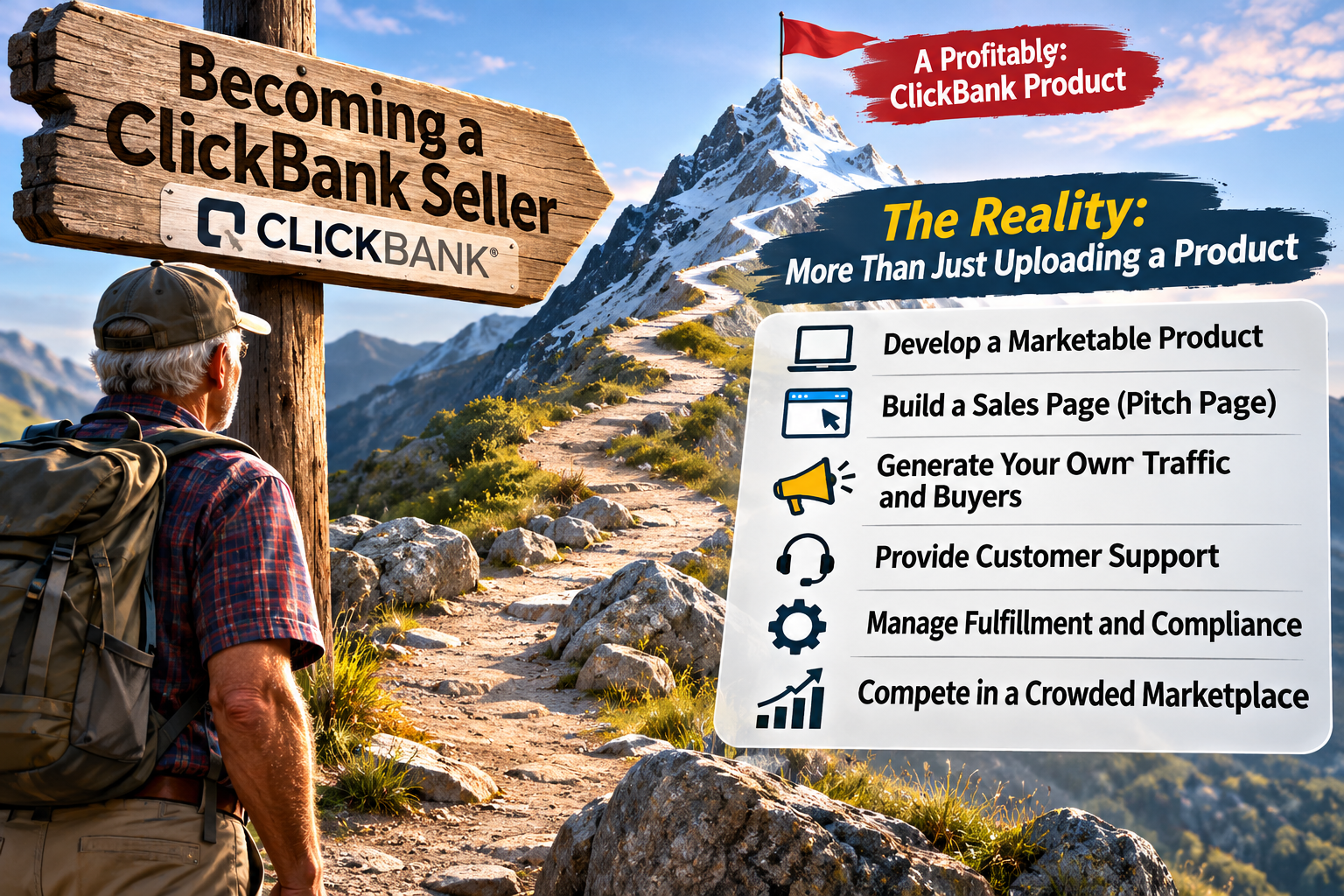
Before the first sale, someone must develop or obtain a suitable product, prepare the sales process, meet ClickBank’s requirements, arrange delivery, and determine how buyers will be attracted in the first place.
The important question is not simply whether ClickBank allows you to sell. It is what you must already have—or be capable of building—to make selling practical.
What Does ClickBank Actually Provide Sellers?
ClickBank provides commerce infrastructure for approved products, including order processing and tools for working with affiliates.
That can eliminate some of the complexity associated with establishing an independent online payment and affiliate management system.
However, ClickBank does not automatically provide a finished business.
A seller is still responsible for essential parts of the operation, including:
- A product customers have a reason to purchase.
- Accurate descriptions and compliant promotional claims.
- A functioning sales page.
- Product delivery or fulfillment arrangements.
- Customer and technical support.
- A viable method for generating sales.
ClickBank provides infrastructure. The seller must supply much of the business that uses it.
This distinction is fundamental.
The First Hurdle: You Need Something Worth Selling
A ClickBank seller is fundamentally different from a ClickBank affiliate.
An affiliate promotes someone else’s product. A seller brings a product to market and assumes responsibilities connected with that product.
The seller must have the legal right to offer the product and meet ClickBank’s applicable product requirements.
This may involve creating original educational material, developing software, obtaining appropriate licensing rights, or preparing another eligible product.
Not every product category is accepted, and different categories have different rules.
An approved listing does not establish that customers want the product. Product quality, buyer demand, competition, credibility, and positioning remain separate business questions.
The hidden requirement: Before ClickBank can help process a sale, there must be a legitimate product and a convincing reason for someone to buy it.
Becoming a ClickBank Seller Requires More Than Registration
Creating a ClickBank account is free. Operating as a seller involves additional steps.
ClickBank’s published seller instructions describe requirements that include preparing the product, setting up relevant website pages, configuring payment links, and submitting the product for review.
Two particularly important components are the sales page and the thank-you page.
The Sales Page
ClickBank calls the seller’s sales page a Pitch Page.
This page must explain what is being offered and provide customers with an appropriate route to purchase through ClickBank.
It is not enough to display an attractive headline and a purchase button. Product descriptions, disclosures, promotional claims, and other required information must comply with ClickBank’s policies.
A sales page also has a commercial purpose: it must give potential buyers sufficient confidence to make a purchasing decision.
ClickBank can process the transaction, but it does not guarantee that the sales message will persuade anyone.
The Thank-You Page
Sellers must also provide an appropriate post-purchase page.
It must explain how customers obtain the product or receive relevant delivery instructions and provide necessary contact information.
The obligation continues after payment.
If the customer cannot access the product, misunderstands the offer, or needs assistance, the seller must have a way to respond.
Website and Technical Requirements
ClickBank’s getting-started instructions state that sellers need their own website arrangements; ClickBank does not provide conventional website hosting.
The seller also needs functional purchase links and a working process for getting the purchased product to the customer.
Someone who does not possess these skills may need outside services, software, or technical assistance.
Those requirements can introduce costs long before a profitable sale occurs.
What Does It Cost to Become a ClickBank Seller?
ClickBank’s published fee schedule identifies a one-time $49.95 activation charge when a seller’s first product is approved.
The company states that registration itself is free and that the activation charge is not owed if the product is not approved.
ClickBank also lists transaction deductions and a $5 processing charge for payments issued to clients.
These fees matter, but they are not necessarily the seller’s largest expense.
Consider what may be required before a product ever reaches the marketplace:
- Product creation, production, or licensing.
- Domain registration and website hosting.
- Sales page preparation and testing.
- Software or technical support.
- Promotional content or advertising.
- Customer service and product maintenance.
The actual amount depends heavily on what the seller already owns, knows, and can perform independently.
A technically experienced creator with an existing audience faces very different startup conditions from someone who has no product, no website, and no established source of buyers.
The $49.95 activation charge is not a realistic measure of the total cost of starting a ClickBank selling business.
We examine transaction-level profitability separately in our investigation of ClickBank seller economics.
Product Approval Is Not Business Validation
ClickBank reviews products and associated materials for compliance with its requirements.
This is an important distinction: approval to use a platform is not the same as evidence of commercial demand.
A compliant product can still fail to attract buyers.
A well-designed sales page can still convert poorly.
A product that appeals to affiliates can still produce disappointing results after commissions, transaction deductions, promotional expenses, refunds, and operating costs.
Approval establishes that a product has met the applicable platform review requirements. It does not prove that the business model will work.
Who Brings the Customers?
One of ClickBank’s most attractive features is its affiliate marketplace.
A seller may be able to recruit independent affiliates who promote approved products in exchange for commissions.
That opportunity deserves attention, but it must be interpreted correctly.
Access to an affiliate marketplace does not guarantee affiliate participation.
Affiliates have choices. They can evaluate competing offers, commission arrangements, promotional materials, conversion potential, refund exposure, and the credibility of the seller.
A new seller without a sales history may face difficulty attracting serious promoters.
The alternative is to generate traffic independently through advertising, search visibility, an existing audience, email marketing, or other legitimate channels.
Each approach involves some combination of money, time, experience, and uncertainty.
The platform does not eliminate the central challenge of online business: acquiring customers at a cost that leaves sufficient profit.
The Responsibilities That Continue After a Sale
The commercial relationship does not end when ClickBank accepts payment.
ClickBank’s seller requirements include responsive customer communications and appropriate support.
Sellers must also consider the consequences of dissatisfied customers, refund requests, product problems, and recurring obligations where applicable.
This has two important implications.
First, the seller is operating an ongoing business rather than simply uploading a product and collecting commissions.
Second, gross sales figures can create a misleading impression of success when the associated expenses and obligations are ignored.
A product may generate substantial transaction volume while delivering much less profit than its headline revenue suggests.
Where the Seller’s Risk Actually Sits
ClickBank provides valuable systems, but using them does not transfer every business risk to the platform.
Consider the division of responsibilities.
ClickBank provides: established transaction infrastructure, applicable marketplace and affiliate capabilities, and platform processes for approved products.
The seller remains responsible for: creating a marketable offer, meeting applicable rules, maintaining required product and website arrangements, supporting customers, and pursuing commercially sustainable sales.
Some services overlap, but the underlying distinction remains.
ClickBank can facilitate commerce. It cannot manufacture customer demand or guarantee that a particular product will succeed.
That is the difference between platform access and business viability.
What Should a Prospective ClickBank Seller Verify First?
Before committing to a product launch, a prospective seller should be able to answer several practical questions.
Is there evidence that people want this product? Personal enthusiasm is not a substitute for demonstrable demand.
Can I produce and deliver the offer legally and reliably? This includes ownership rights, product requirements, fulfillment, and ongoing support.
What will getting ready actually cost? The platform activation charge is only one possible expense.
How will customers discover the offer? Affiliate participation should be treated as a possibility to earn, not a benefit automatically received.
What must happen financially for the business to become profitable? The calculation must include commissions, fees, refunds, marketing expenses, and other operating costs.
If those questions cannot yet be answered, launching may be premature.
That does not establish that the opportunity is poor. It establishes that important parts of the business case are still unknown.
TheIMFactor Verdict: A Platform Is Not a Finished Business
ClickBank can reduce certain technical and commercial barriers to selling products online.
For someone with a legitimate product, an effective sales process, sufficient resources, and a credible customer acquisition strategy, those capabilities may be useful.
But the visible ease of establishing an account conceals a larger collection of requirements.
The product must exist. The selling arrangements must work. The policies must be satisfied. Customers must be acquired. Costs must be controlled. Support obligations must be met.
And none of those activities guarantees profitability.
The essential reality of becoming a ClickBank seller is that the platform provides a route to market—not a substitute for the business that must travel it.
That is what prospective sellers need to understand before discovering the requirements the expensive way.
Primary Sources
- ClickBank Support — How Do I Get Started as a ClickBank Seller?
- ClickBank Support — ClickBank Seller and Products Requirements Policy
- ClickBank Support — Creating Your First Product
- ClickBank Support — What Are ClickBank’s Fees?
- ClickBank Support — Product Guidelines