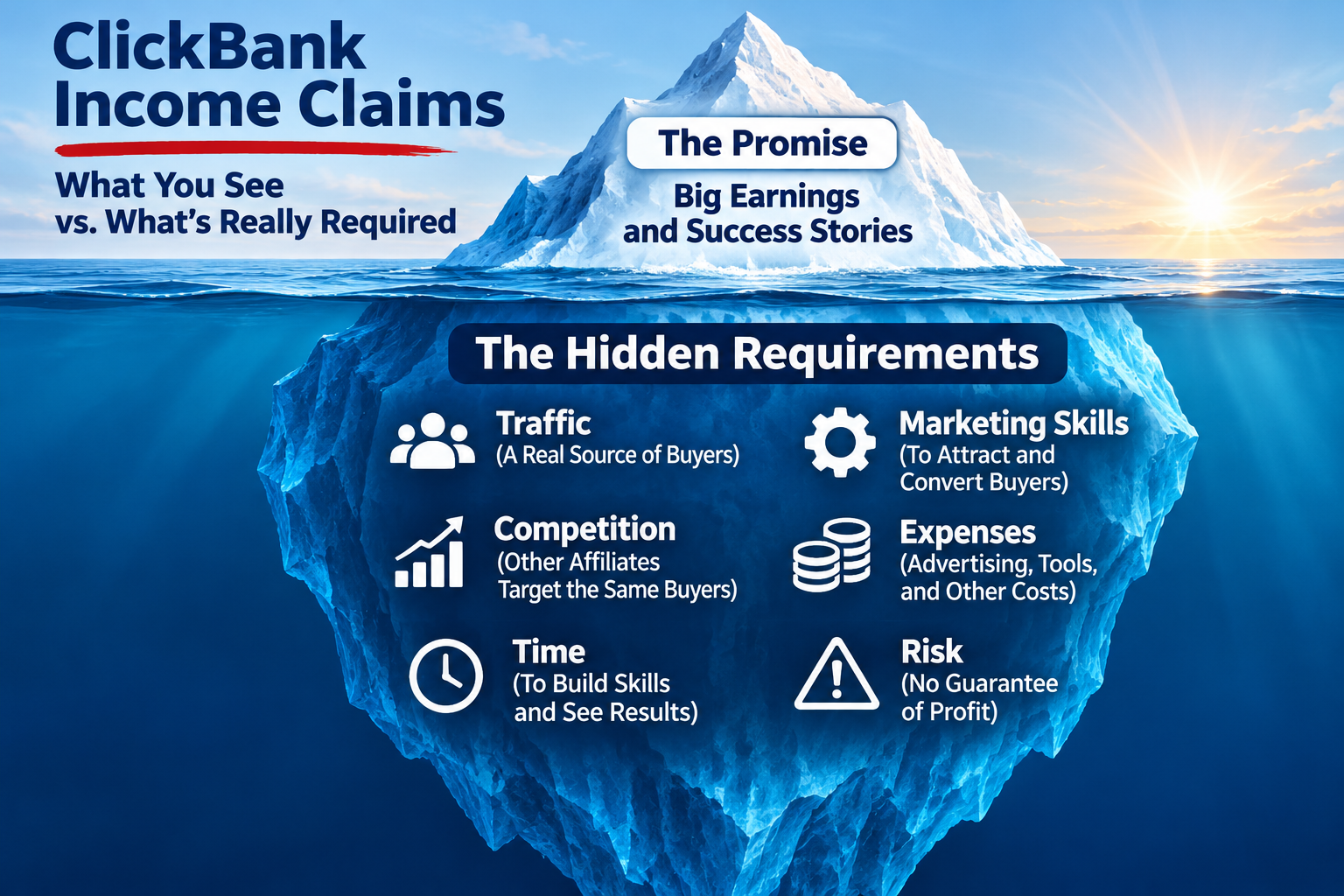
The promise of earning money through ClickBank can be appealing. Create an account, choose a product to promote, attract buyers, and collect commissions. Or develop a product of your own and recruit affiliates to sell it.
Those opportunities are real features of the platform. But the steps required to participate are not the same as the requirements for producing reliable income.
Behind the visible opportunity are questions about skills, traffic, competition, financial resources, customer demand, and the time needed to make a business work.
The hidden requirements behind ClickBank income claims are often more important than the income figures themselves.
The purpose of this investigation is not to dismiss ClickBank or suggest that successful participants are imaginary. It is to examine what an income claim actually establishes—and what it leaves unanswered.
What Do ClickBank Income Claims Actually Tell You?
An income claim may describe how much money someone earned from promoting or selling products.
But a revenue figure, commission screenshot, or success story does not automatically explain how the result was achieved.
Consider someone displaying $10,000 in commissions from a particular period.
That figure does not, by itself, establish:
- How much money was spent on advertising.
- How long the person had been building an audience.
- What software, services, or outside assistance were required.
- Whether the displayed earnings survived later refunds.
- How much of the result represented actual business profit.
- How many other participants attempted similar strategies without comparable success.
The figure might be genuine. But genuine does not mean representative, easily repeatable, or financially attractive after expenses.
The distinction between an authentic result and an adequately explained result is essential.
ClickBank’s Own Rules Recognize the Problem
ClickBank publishes promotional and product guidelines addressing earnings representations.
Its Product Guidelines prohibit certain claims suggesting that making money is dramatically easier than it really is. They also restrict promises about specific earnings from following a small number of techniques.
ClickBank’s Promotional Guidelines require claims to be supportable and place restrictions on misleading portrayals, testimonials, and other advertising practices.
These policies establish an important point: the platform itself recognizes that income-related marketing can mislead when it exaggerates results or conceals important qualifications.
That does not mean every promotional message violates the rules.
Nor does the existence of a policy establish that every individual advertisement has been reviewed or that every claim is reliable.
It means readers should examine the evidence behind the message rather than treating platform participation or product approval as proof of likely financial success.
Hidden Requirement #1: A Reliable Source of Buyers
An affiliate cannot generate commissions merely by selecting a product.
Someone must encounter the promotion, develop sufficient interest, and decide to purchase.
This requires access to potential customers.
Traffic may come from search engines, paid advertising, social media, video content, established websites, email audiences, or other legitimate channels.
Every approach presents its own difficulties.
Paid advertising requires financial resources and the ability to evaluate campaigns.
Search traffic generally requires content, competition analysis, and time for visibility to develop.
Social media requires audience-building and ongoing participation.
An existing customer base or mailing list can be an advantage, but beginners generally cannot assume they possess one.
Access to products is not the same as access to customers.
When a promotional presentation concentrates on the commission available per sale but does not explain where buyers will come from, a fundamental requirement is missing.
Hidden Requirement #2: Skills That Must Be Learned or Purchased
ClickBank’s infrastructure handles important transaction-related functions.
It does not automatically supply the marketing expertise required to generate profitable sales.
An affiliate may need to understand audience research, content creation, sales messaging, traffic measurement, advertising policies, and the fundamentals of conversion.
A seller may need additional capabilities involving product development, website management, fulfillment, compliance, and customer service.
Some participants already possess these skills. Others must develop them, purchase tools, or hire assistance.
This changes the practical meaning of an apparently accessible business opportunity.
Opening an account may be straightforward. Becoming competent at the activities that produce sales can be substantially more demanding.
Hidden Requirement #3: Competition Does Not Disappear
ClickBank offers a marketplace where affiliates can discover products to promote.
Its published Marketplace statistics include measures such as Gravity, conversion rate, earnings per click, and average earnings per conversion.
These figures can help participants evaluate offers. But they do not establish that a newcomer will achieve the same results.
For example, ClickBank describes Gravity as reflecting recent affiliate commission activity using its own calculation.
A product with substantial activity may have demonstrated demand, but it may also attract more competition.
Existing affiliates may already possess established audiences, tested advertisements, marketing experience, and other advantages.
Someone entering the same market without those resources faces different circumstances.
An opportunity can be commercially legitimate while remaining difficult for a particular newcomer to compete in.
Marketplace activity should therefore be interpreted as evidence about the offer—not as a personal earnings forecast.
Hidden Requirement #4: Financial Exposure Comes Before Certainty
The financial burden of participation varies considerably.
An affiliate using existing organic traffic may have relatively modest direct expenses. Another affiliate may spend money testing advertising campaigns before discovering whether the approach is viable.
A seller may need to fund product development, website services, creative work, and support before earning meaningful revenue.
The critical issue is not whether every participant must spend a particular amount.
It is that the amount of financial exposure depends on the chosen approach and the resources already available.
Promotional claims sometimes describe what someone earned without equally explaining what they spent to get there.
A person considering ClickBank should distinguish three figures:
Revenue: Money generated from sales.
Earnings or commissions: Amounts credited to the participant under applicable payment arrangements.
Profit: What remains after relevant business costs, refunds, and other adjustments.
Confusing these figures can make a business appear substantially more successful than it actually is.
Hidden Requirement #5: Time and Experience Matter
Income claims frequently emphasize the result while providing limited information about the preparation that preceded it.
A successful affiliate might have spent years developing an audience, learning marketing skills, and refining promotional methods.
A seller might have created several unsuccessful offers before finding one that attracted sufficient demand.
These possibilities do not invalidate a successful result.
But they matter when someone attempts to judge whether the result is realistic for a beginner.
A screenshot showing earnings during a particular week says little about the months or years of preparation that may have made those earnings possible.
Nor does it establish how quickly another participant could reproduce the result.
Time to first sale, time to consistent sales, and time to profitability are three different questions.
A persuasive opportunity presentation should not encourage readers to treat them as interchangeable.
Hidden Requirement #6: Success Stories Do Not Reveal the Full Distribution
One of the most important questions about any income opportunity is how results vary across participants.
A platform may have highly successful affiliates and sellers alongside people who earn little or nothing.
Publishing a few impressive examples does not establish the proportion of participants who achieve those results.
To evaluate a claim about typical outcomes, readers would need reliable information about a defined population of participants, a meaningful observation period, and the distribution of results.
Without that evidence, we cannot responsibly calculate the likelihood that a particular newcomer will succeed.
This investigation does not assign an invented ClickBank success rate.
The available marketplace metrics and published promotional success stories are not equivalent to independently verified, platform-wide participant profitability statistics.
The absence of sufficient evidence is a reason to acknowledge uncertainty—not fill the gap with a confident percentage.
Hidden Requirement #7: Earnings Must Be Sustainable
A profitable week or month can be encouraging.
It does not necessarily establish the existence of a durable business.
Advertising costs can rise. Competition can change. Customers can lose interest. Product availability, platform policies, and traffic sources can change.
Refunds and other financial adjustments can also affect recorded results.
For affiliates, dependence on a particular seller or traffic channel creates additional uncertainty.
For sellers, continuing product quality, buyer support, and customer acquisition remain ongoing responsibilities.
The relevant question is whether earnings can be maintained at an acceptable cost—not merely whether sales can be generated temporarily.
A short-term success story cannot answer that question by itself.
What the FTC Says About Earnings Claims
The Federal Trade Commission provides guidance concerning misleading earnings representations and business opportunities.
For offers covered by the FTC’s Business Opportunity Rule, sellers making earnings claims must meet specific substantiation and disclosure requirements.
More broadly, deceptive advertising rules prohibit misleading income representations.
The important principle is that income claims require appropriate evidence, and truthful figures can still mislead when material context is omitted.
Not every ClickBank product, affiliate promotion, or training course automatically falls within the Business Opportunity Rule. Applicability depends on the particular offer and its circumstances.
Nevertheless, the underlying consumer question applies widely:
What evidence supports the earnings claim, and what would a typical participant need to do and spend to approach that result?
A credible answer should address more than the most successful example.
How to Evaluate an Income Claim Before Believing It
When examining a ClickBank-related income promise, use these questions:
1. What exactly is being measured? Determine whether the figure represents sales, commissions, gross income, or actual profit.
2. What period does it cover? A single exceptional day is not evidence of reliable monthly earnings.
3. What expenses were involved? Ask about advertising, software, contractors, product costs, and other operating commitments.
4. What prior advantages did the participant possess? Consider experience, audience size, technical resources, and established customer relationships.
5. Is the result typical or exceptional? Look for substantiated information about a defined group rather than isolated testimonials.
6. What is required to reproduce the approach? Identify the practical work, resources, restrictions, and risks.
7. What happens when things go wrong? Consider refunds, failed campaigns, account restrictions, changing market conditions, and unavailable products.
If a promotional message does not answer these questions, the reader has not yet received enough information to assess the opportunity responsibly.
TheIMFactor Verdict: The Income Figure Is Only the Visible Surface
ClickBank offers legitimate commercial infrastructure for affiliates and sellers.
Some participants may develop successful businesses using it.
But the existence of a successful participant does not establish that success is simple, predictable, inexpensive, or typical.
The underlying requirements can include customer acquisition, specialized skills, competition, financial exposure, sustained effort, and continuing operational responsibilities.
A compelling income figure may reveal what someone achieved.
It does not automatically reveal what was required, what was risked, how many others attempted the same thing, or whether another person can reasonably expect a comparable outcome.
The question that matters is not merely, “How much money did someone make with ClickBank?”
It is:
“What did it take to produce that result, and what evidence suggests those conditions are realistically available to me?”
That is the difference between being attracted by an income claim and making an informed business decision.
Primary Sources
- ClickBank Support — Product Guidelines
- ClickBank Support — Promotional Guidelines
- ClickBank Support — How Do I Use the ClickBank Marketplace Stats?
- Federal Trade Commission — Selling a Work-at-Home or Other Business Opportunity?