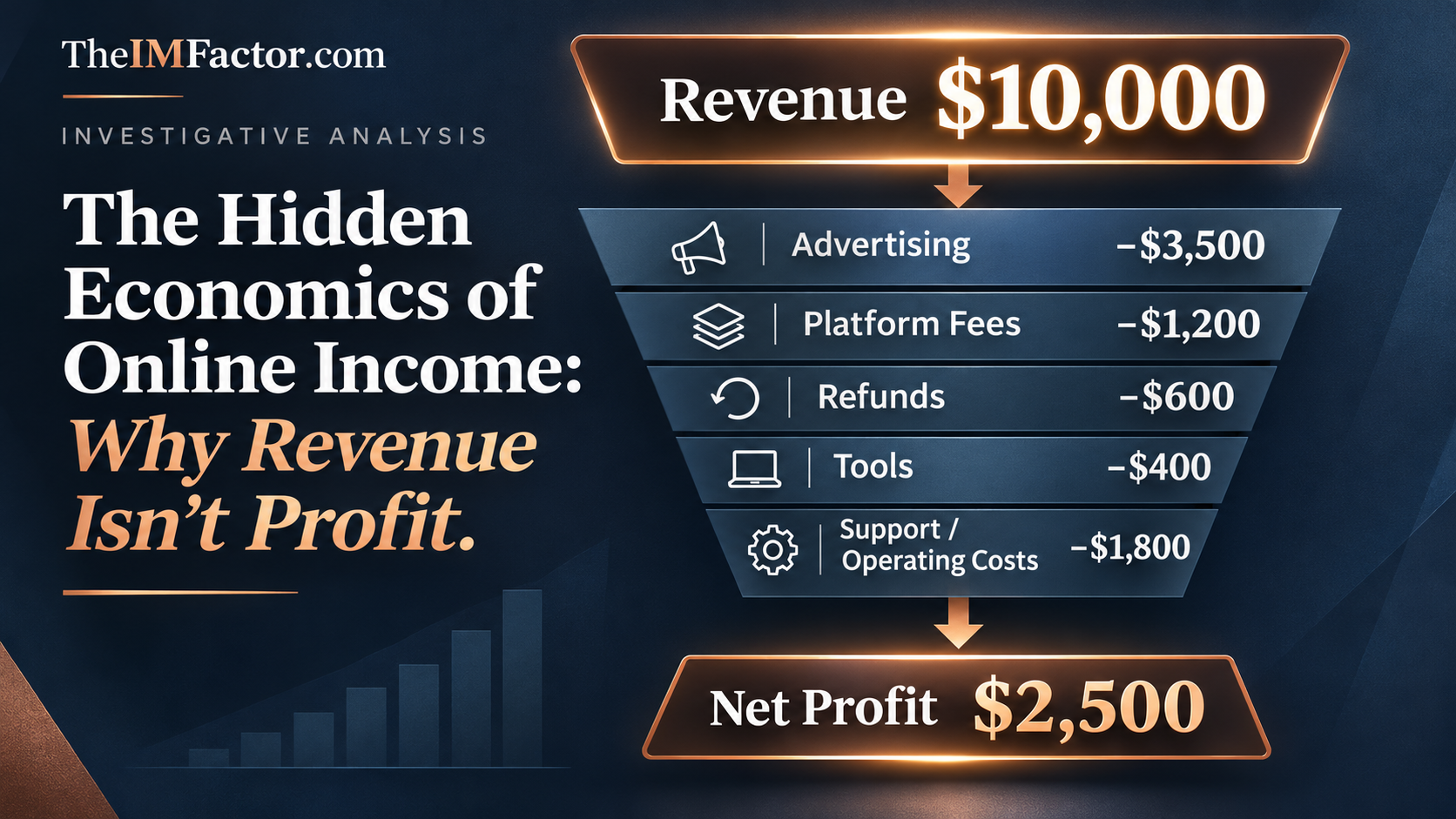
The difference between online income vs profit is often overlooked in success stories that emphasize impressive sales figures while leaving out the expenses required to generate them.
A creator reports earning $10,000 in a month. An affiliate marketer celebrates thousands of dollars in commissions. An online seller announces six-figure sales.
Those figures may be accurate. But they leave an essential question unanswered:
How much money did the person actually keep?
The difference between online income and profit can be substantial. Advertising, platform fees, software, refunds, production expenses, and other costs may consume much of the money a business generates.
Even a financially profitable operation can demand so much time that the return is less attractive than its headline earnings suggest.
The hidden economics of online income begin with understanding what the numbers represent—and what they leave out.
Revenue, Earnings, and Profit: Three Numbers That Are Not Interchangeable
Before evaluating an online business opportunity, distinguish three commonly confused financial measurements.
Revenue is the money generated from sales or other business activities before the relevant costs are deducted. For a seller, this might be the total value of products sold.
Earnings is a less precise term in everyday online marketing. Depending on the context, it might refer to gross sales, affiliate commissions, advertising income, or money remaining after certain deductions. The word alone does not establish profitability.
Net profit is what remains after accounting for the business’s applicable revenue, returns, and expenses. It is not necessarily the owner’s after-tax take-home income.
Consider three online entrepreneurs:
- A digital product seller generates $12,000 in monthly sales.
- An affiliate marketer earns $4,000 in gross commissions.
- A YouTube creator receives $3,000 from advertising and sponsorships.
These numbers describe income-generating activity. They do not tell us how much each business spent to generate those amounts.
Without the expenses, we cannot determine which operation is financially successful—or whether any of them made a profit.
A $10,000 Online Business That Produces Only $700 in Profit
Consider a hypothetical digital product business that generates $10,000 in sales during one month.
Its financial results might look like this:
| Monthly activity | Amount |
|---|---|
| Gross product sales | $10,000 |
| Refunds and customer adjustments | −$800 |
| Payment processing and platform fees | −$650 |
| Advertising expenses | −$4,200 |
| Affiliate commissions | −$2,100 |
| Software and subscriptions | −$350 |
| Product support and miscellaneous costs | −$1,200 |
| Net operating profit | $700 |
This is a hypothetical illustration, not a representation of typical results on any particular platform.
The business generated $10,000 in gross sales, but retained just $700 in operating profit before income taxes and any additional expenses not included in the illustration.
That represents a 7% operating profit margin measured against gross sales.
A promotional presentation emphasizing the $10,000 sales figure could create a very different impression from one reporting the $700 profit.
Both numbers describe aspects of the same business. Only the complete financial picture reveals the outcome.
And the calculation still leaves another important question: how much time did the owner spend producing that result?
The Expenses That Online Income Presentations May Overlook
Different online business models have different cost structures. Still, several categories of expense repeatedly influence profitability.
Customer Acquisition: The Cost of Getting Someone to Buy
Customer acquisition can be among the most important financial variables.
A business may pay for advertising, produce content, hire specialists, build websites, or invest substantial time establishing an audience.
Some costs are immediately visible, such as a paid advertising bill. Others are less obvious, including equipment, research, and hours spent creating content that never attracts customers.
Imagine spending $600 on advertising and generating ten qualifying sales that produce $50 each in gross commissions.
The commissions total $500.
Advertising alone has already exceeded the commissions by $100, before considering other expenses.
The campaign generated revenue. It did not generate a profit.
Conversely, an unpaid-content strategy might avoid advertising charges but require months of work before attracting meaningful traffic.
Traffic is not economically free merely because no advertising invoice arrives.
Platform Charges and Transaction Fees
Digital businesses often depend on platforms that provide marketplaces, payment processing, audience distribution, or monetization systems.
These services can be valuable. They can also influence how much revenue the participant retains.
Depending on the business model, costs may include transaction charges, marketplace commissions, payment-processing fees, subscription payments, or revenue-sharing arrangements.
Fee structures vary by platform and may change over time.
Therefore, a claim such as “I sold $5,000 worth of products” tells us little until we know what portion of those sales remained with the seller.
The relevant question is not simply how much the platform helps generate. It is how much value remains after paying for that infrastructure.
Refunds, Chargebacks, and Reversals
Not every completed transaction produces permanently retained revenue.
Customers may request refunds. Payment disputes can create additional expenses. Certain commissions may be reversed when underlying purchases are refunded.
A seller reporting gross sales without subtracting refunds can overstate the revenue ultimately retained.
An affiliate reporting credited commissions without accounting for later reversals may face a similar problem.
A meaningful profitability calculation should reflect the actual revenue retained under the applicable transaction rules.
Tools, Production, and Ongoing Operations
Online businesses frequently rely on an assortment of supporting resources.
Examples include:
- Website hosting and domain registration.
- Email, analytics, and marketing software.
- Design and video-production applications.
- Equipment and equipment replacement.
- Contractors or professional assistance.
- Product delivery and customer support.
- Training, research, and testing expenses.
Not every business incurs all these costs, and some may operate with relatively modest overhead.
The investigative issue is whether material expenses have been included—not whether every online entrepreneur must purchase the same tools.
Break-Even: How Many Sales Are Actually Necessary?
A business does not become profitable merely because it generates sales. The money remaining from those sales must be sufficient to cover its operating costs.
The U.S. Small Business Administration identifies break-even as the point where total revenue equals total costs.
For a business selling one product, a useful calculation is:
Break-even sales = Fixed costs ÷ (Selling price per unit − Variable cost per unit)
Suppose a creator sells a digital product for $40.
The creator retains $30 per sale after $10 in variable costs, and has $600 in monthly fixed operating expenses.
The business would need:
$600 ÷ $30 = 20 sales to break even.
At 20 sales, the contribution from sales covers the assumed fixed costs. It does not yet generate an operating profit.
At 30 sales, the business would generate $300 in operating profit under the same assumptions.
This example is hypothetical. Real businesses may sell several products with different margins, incur additional variable costs, or experience refunds that change the calculation.
The broader lesson is straightforward:
A business opportunity becomes economically meaningful only when the margin on actual sales can cover the expenses required to produce them.
Why Online Income Looks Different Across Business Models
The same financial principle applies across the internet, but the costs and operating responsibilities differ.
| Business model | Attractive visible figure | Less visible economic questions |
|---|---|---|
| Affiliate marketing | Commission earnings | Traffic costs, tools, refunds, time spent promoting |
| Digital products | Gross sales revenue | Platform charges, affiliate payments, support and marketing |
| YouTube and content creation | Advertising and sponsorship income | Production time, equipment, editing, contractors and audience development |
| Online marketplaces | Shop revenue and order volume | Listing and transaction fees, materials, shipping, returns and advertising |
| Social media marketing | Reach, engagement and conversion claims | Acquisition costs, campaign expenses, labor and the actual value of resulting sales |
These businesses cannot be evaluated solely by their headline financial figures.
A creator with modest revenue and low expenses might retain more profit than a seller reporting much higher sales.
A high-volume affiliate campaign might earn substantial commissions while losing money on advertising.
An online store might experience rising sales and simultaneously face declining profitability because its customer-acquisition costs increase.
Revenue growth is potentially valuable, but the financial result depends on what it costs to achieve that growth.
The Cost That Doesn’t Appear on the Platform Dashboard: Your Time
Even after accounting for direct operating expenses, a business owner must consider the value of the work involved.
Suppose an online venture produces $600 in monthly operating profit.
If the owner spent 60 hours operating the business that month, the result is equivalent to $10 per hour before personal income taxes.
That is a measure of the owner’s effective return on time, not an employee wage or a formal accounting profit calculation.
It may still be worthwhile if the owner is developing valuable skills, building a business asset, or enjoying the work.
But those potential benefits should be recognized as separate considerations rather than used to disguise a weak current financial return.
An enterprise that becomes more efficient over time may eventually justify its early investment. That possibility, however, is not a guaranteed outcome.
Unpaid time is not necessarily an accounting expense, but it is a real economic commitment.
Profitability and Cash Flow Are Different Problems
A business can show an accounting profit and still experience financial strain.
For example, money may be tied up in inventory, customer payments may arrive after bills are due, or funds may be held in reserve to cover potential refunds.
Equipment purchases and loan repayments can also affect available cash differently from how expenses are recognized in accounting records.
This distinction matters because a profitable business may still need additional cash to keep operating.
Prospective participants should ask two separate questions:
- Does the business generate a reasonable profit over time?
- Will sufficient cash be available when its obligations must be paid?
These questions are related, but they are not interchangeable.
A reliable analysis should consider both.
What Earnings Claims Can Tell You—and What They Cannot
An earnings claim may show that a particular result occurred.
It does not necessarily establish that the result was typical, repeatable, profitable, or achievable by someone with different skills and resources.
A screenshot of revenue or commissions cannot, by itself, establish:
- The total cost of generating the income.
- Whether refunds or reversals occurred afterward.
- How long the person worked to achieve the result.
- Whether the business had profitable and unprofitable months.
- Whether the result was unusual compared with other participants.
- Whether the same conditions are available to a newcomer.
The Federal Trade Commission has emphasized the importance of supporting earnings claims with reliable evidence. Exceptional individual outcomes should not be presented as proof that others are likely to achieve similar results.
That does not make every success story false or every promotional claim misleading.
It means that accurate individual results and representative expectations are different forms of evidence.
Before accepting an income claim as meaningful, ask what period it covers, which expenses were included, whether it represents a net result, and what evidence exists about less successful participants.
Where reliable information about typical outcomes is unavailable, that uncertainty should be acknowledged rather than replaced with an invented success percentage.
A Practical Financial Reality Check Before You Commit
You do not need sophisticated accounting software to begin evaluating an online business opportunity.
Start by documenting the assumptions on which its advertised economics depend.
1. Identify the actual revenue source.
Will you receive commissions, product-sale proceeds, advertising revenue, sponsorship payments, or some combination?
Determine whether quoted amounts are gross sales, credited earnings, or money actually paid to participants.
2. Estimate your direct costs.
Include platform charges, advertising, transaction expenses, product costs, contractor payments, software, refunds, and other material operating expenses.
3. Calculate a realistic break-even point.
Determine how many qualifying sales, customers, or revenue-generating transactions would be necessary to cover the relevant costs.
4. Set a financial exposure limit.
Decide how much you can afford to spend before the model demonstrates a worthwhile result.
5. Account for your time.
Estimate how many hours the business requires, including learning, preparation, marketing, administration, and troubleshooting.
6. Examine evidence rather than projections alone.
Look for actual customer demand, tested conversion economics, reliable transaction records, and credible documentation of the claimed outcomes.
7. Define when you will reassess.
Establish conditions that would justify continuing, changing strategy, or stopping.
These steps cannot guarantee profit. They can help prevent an attractive revenue projection from being mistaken for an established business opportunity.
The Bottom Line: Revenue Is Evidence of Activity, Not Proof of Success
Online platforms can help individuals reach customers, distribute products, earn commissions, and establish businesses that would once have required far more infrastructure.
Those are genuine advantages.
But access to monetization does not eliminate the basic economics of running a business.
Revenue must be weighed against the costs of generating it. Profit must be considered alongside cash flow, unpaid labor, risk, and the sustainability of the operation.
The most revealing question about an online income opportunity is not simply, “How much can it generate?”
It is:
“After everything required to generate that income, what will actually remain—and is that return worth the resources involved?”
That question takes the investigation beyond the sales pitch and closer to the financial reality.
Continue the Investigation
The financial principles examined here apply across the platforms covered by The IM Factor.
For a platform-specific examination, read The True Economics of ClickBank Affiliate Marketing: Costs, Break-Even, and Profit, which investigates how marketing expenses and commissions affect affiliate profitability.
For a broader examination of promotional expectations, read The Hidden Requirements Behind ClickBank Income Claims.
Explore the ClickBank Investigation Library for additional research on participation costs, affiliate risks, seller economics, and profitability.
Research reviewed: November 7, 2026. Financial illustrations are hypothetical and do not describe typical participant earnings. This investigation provides general educational information rather than individualized financial, accounting, or tax advice.