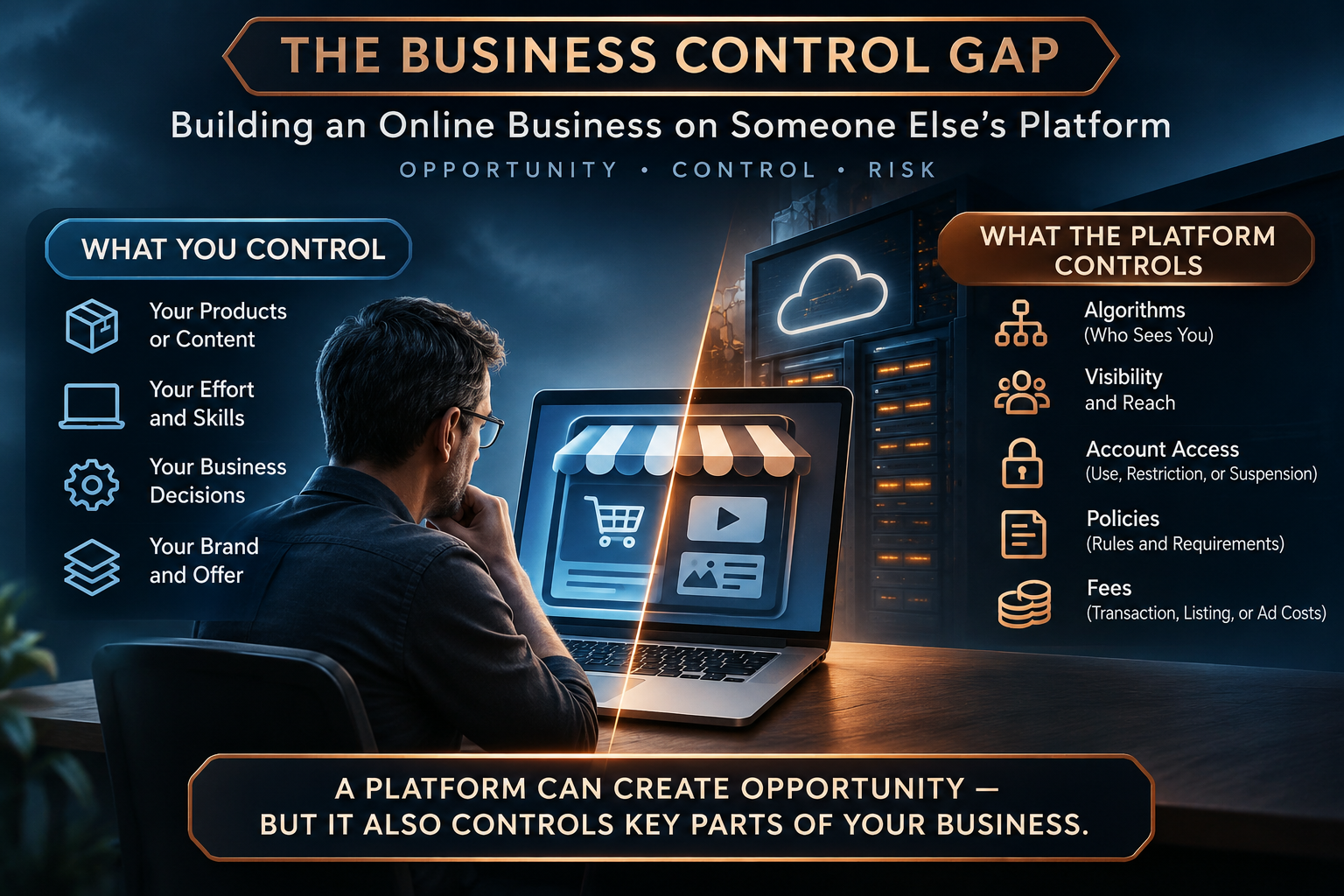
Platform dependence is one of the least visible risks of building an online business.
A seller opens a successful marketplace shop. A creator builds an audience on YouTube. An affiliate relies on social media to attract customers.
Over time, the platform may become essential to their income.
But the business owner does not control the platform’s rules, algorithms, fees, or decisions about account access.
The question isn’t whether online platforms are useful. It’s how much of your business you can afford to place under someone else’s control.
The Difference Between Using a Platform and Controlling Your Business
Platforms provide valuable infrastructure.
They help businesses reach customers, process transactions, distribute content, manage payments, and operate without developing every system independently.
In exchange, participants agree to rules established by the platform operator.
That arrangement can be beneficial to both sides.
The risk emerges when a business becomes so dependent on one platform that changes beyond its control can threaten its operations.
A seller may own the products being offered but not control marketplace visibility. A creator may produce every video but not control the recommendation system distributing it.
Owning the work does not necessarily mean controlling how customers discover it.
Four Ways Platform Dependence Creates Business Risk
1. Algorithm Changes Can Alter Customer Reach
Search engines, marketplaces, and social networks use ranking and recommendation systems to decide which content or products people see.
Those systems can change.
A business that once attracted dependable traffic might experience a decline in visibility even when its products, content, or marketing effort remain substantially unchanged.
That does not automatically mean the platform is acting unfairly. Changes may reflect competition, user behavior, quality improvements, or efforts to protect customers.
But the financial consequences for dependent businesses can still be significant.
The hidden risk: Customer access that appeared dependable may never have been guaranteed.
2. Account Restrictions Can Interrupt Operations
Platforms establish rules covering content, advertising, seller conduct, payment activity, security, and other matters.
Violations can lead to restrictions or suspension. Certain security concerns and verification requirements can also interrupt access.
For example, YouTube’s monetization policies describe circumstances under which creators can lose access to earning features.
Etsy’s seller policies explain conditions under which listings, shops, or payment accounts may be restricted.
Such rules serve legitimate purposes, including fraud prevention and customer protection.
However, a business relying heavily on a single account may experience serious disruption when that account becomes unavailable.
The hidden risk: A business may remain commercially viable while losing temporary or permanent access to an important sales channel.
3. Changing Fees Can Reduce Profitability
Platforms can modify their pricing structures, transaction charges, advertising arrangements, or other commercial terms.
Those changes may be reasonable from the operator’s perspective.
For participants, however, even modest increases can affect profitability.
A seller operating with a narrow profit margin may have limited room to absorb additional expenses.
An affiliate relying on paid traffic may face similar pressure when customer-acquisition costs rise.
The issue is not that platforms should never change their charges.
It is that participants need sufficient financial flexibility to operate when conditions change.
The hidden risk: A business model that works under today’s economics may become less attractive under tomorrow’s.
4. Your Audience May Not Be Fully Portable
Building followers or customers through a platform creates valuable connections.
But those relationships may not be easily transferred elsewhere.
A creator with thousands of followers cannot assume those people will automatically follow them to another service.
A marketplace seller may be restricted in how customer information can be used outside the marketplace.
A business that relies on platform-based recommendations may therefore face substantial difficulty replacing lost traffic.
The hidden risk: Audience size can create the appearance of independence without guaranteeing an independent means of reaching those people.
A Simple Example of Concentration Risk
Consider a hypothetical online business generating $4,000 in monthly revenue.
Suppose $3,200 comes from one marketplace and the remaining $800 from other sources.
That means 80% of its revenue depends on one sales channel.
If sales through that marketplace suddenly declined by half, total monthly revenue would fall to $2,400, assuming the other revenue remained unchanged.
The business would lose 40% of its overall revenue.
This illustration is hypothetical. It does not represent typical outcomes on any platform.
It demonstrates why dependence matters even when a business is currently successful.
A sudden reduction in one important channel can have consequences far beyond that channel itself.
How to Reduce Platform Dependence
Complete independence from third-party services is rarely practical for a digital business.
Even an independent website may rely on hosting companies, payment providers, search engines, and other outside services.
The objective is therefore not to eliminate every dependency, but to avoid unnecessary concentration of risk.
Several practices can help:
- Diversify customer acquisition. Develop more than one realistic source of traffic or sales rather than relying entirely on a single algorithm or marketplace.
- Build direct customer relationships where permitted. An independent website or permission-based customer communications may reduce reliance on platform-controlled discovery.
- Maintain appropriate backups. Preserve original content, product files, transaction records, and other business information that can lawfully be retained.
- Understand the rules. Review relevant platform policies, account-security requirements, and available appeal procedures.
- Monitor financial exposure. Know how much revenue depends on each platform and whether the business could withstand a significant interruption.
- Prepare alternatives. Identify what could realistically be moved to another channel and what would need to be rebuilt.
These precautions have costs of their own.
Operating several channels requires additional time, skills, and resources. Diversification should therefore be proportionate to the business’s actual size and risks.
When Platform Dependence Is an Acceptable Trade-Off
Dependence is not automatically a reason to avoid a platform.
A marketplace may provide access to customers that a small business could not economically reach on its own.
A social network may help a creator establish an audience without substantial upfront infrastructure costs.
A payment or affiliate network may simplify functions that would otherwise be expensive to operate independently.
For many participants, those advantages justify accepting a degree of dependence.
The important issue is whether the business owner recognizes the trade-off.
A platform can be an excellent business partner without being a permanent or guaranteed source of customers and income.
The Bottom Line: Build a Business That Can Survive Change
Online platforms create opportunities that would otherwise be difficult or expensive to access.
But the convenience of participating can obscure an important reality: the platform operator retains considerable control over the environment in which participants operate.
Policies can change. Visibility can decline. Fees can increase. Accounts can be restricted.
None of these outcomes is inevitable, and none means that participation is inherently unwise.
The practical question is how well the business could respond if one of them occurred.
A sustainable online business should understand its platform dependencies before those dependencies become a financial emergency.
The goal is not to avoid platforms. It is to use them without allowing any one of them to become an unquestioned guarantee of future success.
Related Investigations
The Hidden Economics of Online Income: Why Revenue Isn’t Profit
Examine how operating expenses and changing business costs affect actual profitability.
The Psychology of Online Marketing: How Sales Pitches Influence Decisions
Understand how promotional presentations can emphasize attractive opportunities while leaving practical limitations unexplained.
Explore the Forensic Lab
Find additional investigations into online business costs, income claims, marketing psychology, and risk.
Research reviewed: November 7, 2026. Platform policies and fees are subject to change. This investigation discusses documented platform powers and general business-risk principles; it does not imply that most participants experience account restrictions or substantial losses.