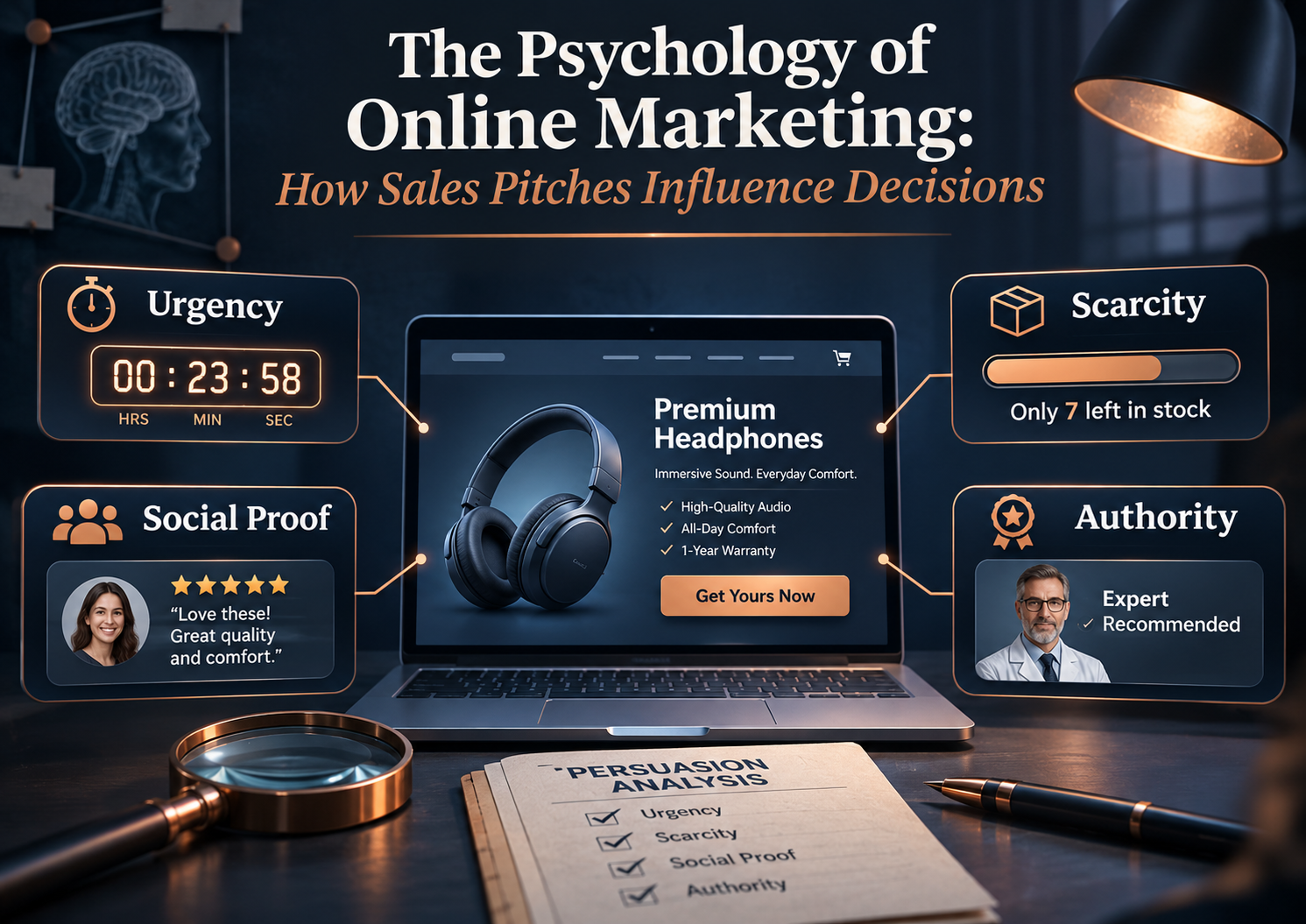
The psychology of online marketing helps explain why a sales presentation can feel convincing before we’ve fully evaluated what is being offered.
A countdown clock creates urgency. A collection of glowing testimonials builds confidence. A compelling success story makes an opportunity feel achievable.
These techniques can influence purchasing decisions, but they do not necessarily tell us whether a product, platform, or business opportunity is worthwhile.
The important question is not simply whether a sales pitch is persuasive. It’s whether the persuasion is supported by reliable information.
Why Online Sales Pitches Work
A successful sales presentation does more than explain product features. It helps prospective customers imagine a desirable outcome.
Online marketing frequently combines emotional appeals with familiar decision-making cues: urgency, popularity, authority, and the fear of missing an opportunity.
These cues can make complex decisions feel simpler.
That isn’t inherently wrong. Clear demonstrations, genuine recommendations, and truthful limited-time offers can help customers make informed choices.
Problems arise when persuasive techniques create expectations that the available evidence cannot support.
Five Techniques Worth Recognizing
1. Urgency: Encouraging You to Act Before You Think
Messages such as “Offer ends tonight” or “Last chance to enroll” encourage immediate action.
Sometimes deadlines are genuine. A scheduled event, limited enrollment period, or temporary discount can have legitimate practical reasons.
But an artificial countdown that repeatedly resets creates a different impression.
The Federal Trade Commission identifies misleading countdown timers and false time limitations among the deceptive design techniques sometimes called dark patterns.
What to ask: Is the deadline real, and what would actually happen if I waited?
A genuine opportunity should be understandable even when you’re not being rushed.
2. Scarcity: Making Something Seem More Valuable Because It’s Limited
Claims such as “Only three places remain” suggest that availability is restricted.
Scarcity can increase a product’s perceived desirability. Research indicates that its influence varies by product type, the reason for the limitation, and the buying situation.
A genuinely limited quantity is useful information.
An unsupported scarcity claim is not.
For digital products, particularly, it is worth asking what creates the limitation. Limited customer support or personal instruction may justify restricted enrollment. An automatically delivered downloadable file may not face the same constraints.
What to ask: What exactly is limited, and can that limitation be verified?
3. Social Proof: The Influence of Other People’s Decisions
Testimonials, reviews, customer counts, and statements about popularity can create confidence.
People naturally consider the experiences of others when evaluating unfamiliar products.
But popularity and suitability are different things.
A testimonial may be authentic without representing the experience of most buyers. A product might be widely purchased without being appropriate for your needs.
The FTC’s advertising guidance addresses misleading endorsements, manipulated reviews, and failures to disclose relevant financial relationships.
What to ask: Are the endorsements genuine, representative, and independent—or does someone benefit financially from my purchase?
4. Authority: Borrowing Credibility From Experts and Successful People
Sales presentations may feature professional credentials, industry awards, influential personalities, or impressive business achievements.
Relevant expertise can provide useful information.
But credibility in one area does not automatically establish the accuracy of every claim made about a product or opportunity.
Someone may be an accomplished entrepreneur without possessing reliable evidence about what a beginner is likely to achieve.
What to ask: Does the person’s expertise directly support the claim being made, and can that claim be independently verified?
5. Emotional Appeals: Selling the Desired Future
Some online-business promotions emphasize freedom, independence, financial security, or escaping an unsatisfying job.
These aspirations are understandable.
A persuasive presentation may encourage viewers to picture their lives after achieving the promised result, while devoting less attention to the preparation, costs, competition, and uncertainty involved.
The emotional appeal is not necessarily false. The concern is whether it overwhelms the practical information needed to make a sound decision.
What to ask: Am I evaluating the actual opportunity—or responding mainly to the future the advertisement asks me to imagine?
When Persuasion Becomes Misleading
The dividing line isn’t simply whether a technique influences behavior.
Virtually all marketing attempts to influence decisions.
The more important distinction is whether the presentation gives consumers an accurate understanding of material facts.
Compare these examples:
| Legitimate persuasion | Potentially misleading persuasion |
|---|---|
| A genuine discount ending on a stated date | A countdown that resets indefinitely |
| A truthful customer testimonial with appropriate context | An exceptional testimonial implying typical results without support |
| A clear explanation of limited enrollment | An invented shortage designed to force a purchase |
| A disclosed affiliate recommendation | An undisclosed paid endorsement that appears independent |
The right-hand examples describe practices that warrant scrutiny; whether a particular advertisement violates the law depends on its facts and overall presentation.
The FTC has documented deceptive online designs that create false impressions, obscure important information, or interfere with informed consumer decisions.
These practices matter because a buyer can be influenced not only by what an advertisement says, but also by how information is presented or withheld.
A Practical Test Before You Buy
When a promotional offer feels unusually compelling, ask five questions:
- What is actually being promised? Separate specific, verifiable claims from attractive possibilities.
- What evidence supports the claims? Look beyond testimonials and isolated examples.
- What information is missing? Examine total costs, prerequisites, limitations, and risks.
- Who benefits from my decision? Consider commissions, referrals, and other promotional incentives.
- Would I still want this if the urgency disappeared? Evaluate the offer without the pressure of a deadline or scarcity message.
These questions don’t require rejecting every persuasive advertisement.
They simply restore attention to the product, the evidence, and your own circumstances.
The Bottom Line: Persuasion Isn’t Proof
Effective marketing can make a product understandable, desirable, and memorable.
That can benefit both businesses and consumers.
But persuasive presentation and reliable evidence are not interchangeable.
Urgency cannot establish value. Popularity cannot guarantee suitability. Authority cannot replace substantiation. Emotional appeal cannot eliminate financial risk.
The strongest defense against a misleading sales pitch is understanding what the presentation is asking you to believe—and what the evidence actually supports.
That is the distinction between being persuaded by an opportunity and making an informed decision about it.
Continue the Investigation
Online Income Claims: What Success Stories Don’t Prove
Examine how selected testimonials and exceptional results can influence expectations without establishing what most participants experience.
The Hidden Economics of Online Income: Why Revenue Isn’t Profit
Understand why attractive revenue figures may conceal substantial operating expenses.
Discover more investigations into the financial and psychological realities behind online marketing opportunities.
Research reviewed: November 7, 2026. This investigation discusses general advertising practices rather than making allegations about any particular company or promotion.