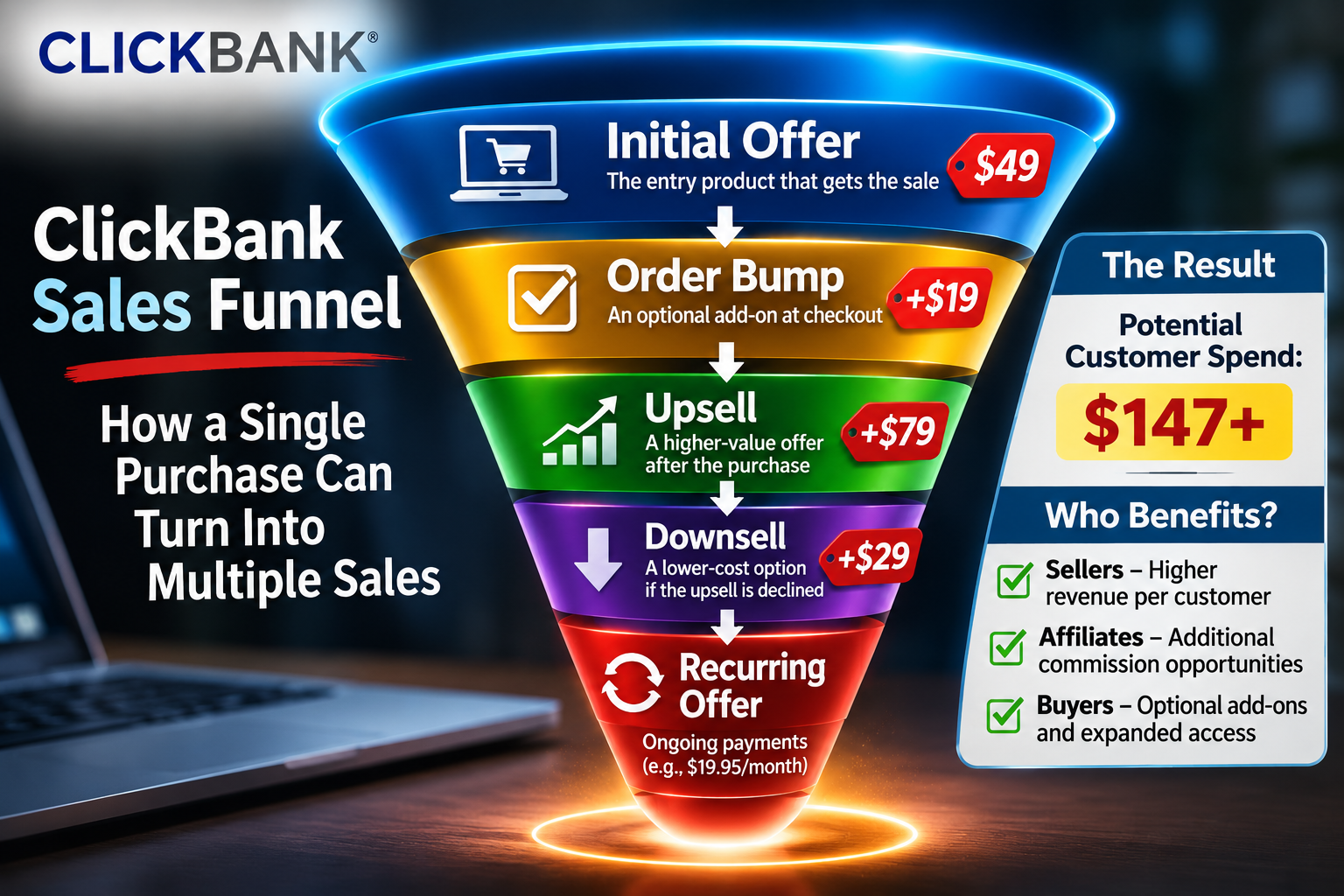
ClickBank sales funnels can turn a single product purchase into a series of additional buying opportunities. A customer who initially agrees to one purchase may encounter optional add-ons, post-purchase offers, and subscriptions that generate further payments.
For sellers, these arrangements can increase the revenue generated from each customer. For affiliates, they can create additional commission opportunities. For buyers, they can provide useful complementary products—or introduce additional purchasing decisions they did not anticipate when they first encountered the offer.
Understanding ClickBank sales funnels means looking beyond the advertised product price to examine the entire purchasing process.
The important question is not simply whether a funnel generates more sales. It is how those additional transactions work, who receives the money, and what the buyer is actually agreeing to purchase.
What Are ClickBank Sales Funnels?
A ClickBank sales funnel is the sequence of offers and purchasing steps a customer encounters when buying a product.
The process typically begins with a promotional page, followed by an order form. Depending on how the seller has configured the offer, the customer may encounter optional add-ons before checkout and additional offers after the initial purchase.
ClickBank provides systems for managing these arrangements through its commerce platform.
A funnel may involve several components:
- Initial offer: The product that attracts the customer.
- Order bump: An optional additional purchase presented on the order form.
- Upsell: An additional offer presented after the initial purchase.
- Downsell: An alternative offer, often at a lower price, presented after another offer is declined.
- Recurring product: A subscription or other arrangement involving future scheduled payments.
Not every ClickBank product uses all these components. Some use a straightforward purchase process without additional offers.
The distinction matters because a product’s advertised purchase price may represent only the beginning of the customer’s potential spending.
How ClickBank Order Bumps Work
An order bump is an optional additional product presented while a customer is completing an order.
For example, someone purchasing a $49 digital training program might be offered a related $19 workbook on the checkout page.
If the buyer selects that option, the additional product becomes part of the purchase.
ClickBank’s order bump system allows sellers to present complementary products directly on the order form.
The customer makes the decision before completing checkout.
An order bump increases the potential value of an order without requiring the customer to begin a separate shopping process.
From the seller’s perspective, this creates an opportunity to earn additional revenue from a customer who is already prepared to buy.
From the customer’s perspective, the relevant questions are whether the additional product is useful, whether the price is clear, and whether the purchase is genuinely optional.
A related product can provide value. But an attractive add-on is not automatically necessary to obtain the benefits promised by the original product.
What Happens After the First Purchase?
ClickBank also supports post-purchase upsell flows.
These begin after the customer has completed the initial transaction.
A buyer might purchase a $49 training program and then be offered a $79 advanced course.
If the buyer accepts, the additional transaction can be completed using the payment information from the original purchase without requiring that information to be entered again.
ClickBank’s standard upsell-flow documentation describes a sequence of up to three additional offer steps. Some advanced capabilities require special access.
The seller can configure what happens depending on whether the customer accepts or declines an offer.
For instance:
- The customer buys the original product.
- An advanced product is offered.
- If the customer accepts, another complementary product may be offered.
- If the customer declines, the funnel may present an alternative offer or proceed to confirmation.
These are separate purchasing decisions, not automatic proof that the original product was inadequate.
Nevertheless, the arrangement changes the commercial relationship.
The initial sale may become the entrance to a larger set of transactions.
Downsells: Another Opportunity After a Declined Offer
A downsell is commonly presented when a customer declines another offer.
Suppose someone purchases the original product but rejects a $79 advanced package.
The seller might respond by offering a smaller package for $29.
This gives the customer another opportunity to purchase while keeping the overall offer within a price range the customer may find more acceptable.
For sellers, a downsell can recover additional sales that would otherwise be lost.
For buyers, it may provide a less expensive alternative.
But the buyer should still evaluate the downsell on its own merits.
A reduced price does not necessarily mean an offer is valuable, and rejecting an upsell does not create an obligation to purchase an alternative.
Who Benefits Financially From Additional Offers?
ClickBank sales funnels create different incentives for sellers and affiliates.
A seller may benefit when an existing customer purchases more products. This can increase total revenue without requiring an entirely new customer acquisition.
Affiliates may also benefit because ClickBank’s revenue-share system can credit the referring affiliate for qualifying purchases made within an upsell flow.
However, affiliate commissions can differ between products.
A seller might offer one commission rate for the initial product and another for an upsell.
ClickBank also supports cost-per-action, or CPA, commissions. Under that arrangement, affiliates receive an agreed fixed payment for a qualifying initial sale rather than earning additional percentage commissions on upsells or recurring payments.
An additional customer purchase does not necessarily create the same financial benefit for every participant.
The precise outcome depends on the product, applicable fees, commission arrangements, refunds, and the customer’s purchasing choices.
Understanding these differences is essential when evaluating what a sales funnel actually produces.
A Simple Example: How a Funnel Increases Customer Spending
Consider a hypothetical ClickBank offer containing three potential purchases.
| Offer | Customer price |
|---|---|
| Initial digital product | $49 |
| Optional order bump | $19 |
| Optional post-purchase upsell | $79 |
| Potential combined spending | $147 |
The customer initially encounters a $49 product.
If the customer voluntarily purchases both additional offers, total spending rises to $147.
That is three times the price of the initial product.
The example illustrates potential customer spending—not the seller’s profit or the affiliate’s commissions.
Each transaction may involve different deductions, commission arrangements, and possible refunds.
A customer who declines both additions spends only the initial $49, before any applicable taxes or other charges.
This is why sales funnel analysis must distinguish the advertised entry price from the potential total cost of participating in the full offer sequence.
Recurring Billing Adds Another Dimension
Some ClickBank products use recurring billing.
Instead of making only a one-time payment, the customer agrees to a subscription or another arrangement involving future charges.
For example, a program might require an initial $29.95 payment followed by $19.95 monthly payments.
If the customer remains subscribed for six months including the initial payment and five subsequent monthly charges, the total would be $129.70, before any applicable taxes or adjustments.
This example is illustrative and does not represent a particular ClickBank product.
ClickBank’s recurring-product documentation allows sellers to establish different affiliate commission rates for initial purchases and subsequent subscription payments.
Recurring billing can generate revenue over a longer period, but only while the relevant charges are successfully collected and remain valid.
Customers may cancel, payments may fail, and refunds may affect financial results.
ClickBank also requires clear customer agreement to recurring billing terms when subscriptions are offered within upsell flows.
A recurring purchase should never be confused with a one-time transaction.
The billing frequency, amount, cancellation terms, and nature of the continuing obligation are central to understanding the offer.
Does the Sales Funnel Make the Original Product Better?
Not necessarily.
An upsell or order bump can provide genuinely useful additional material.
A training program might offer specialized instruction that is not necessary for everyone. A software product might offer an optional service that some customers find worthwhile.
But additional offers can also raise an important question:
Does the original product deliver the promised value on its own, or does the customer need to spend substantially more to obtain the expected result?
There is no universal answer.
The distinction must be evaluated through the actual product description, sales claims, purchase terms, and customer experience.
A seller offering complementary products is not inherently doing anything improper.
The concern arises when the buying process obscures material costs, creates misleading expectations, or pressures customers into purchases they do not understand.
ClickBank’s published upsell requirements address some of these risks by requiring clear prices and prominent options to accept or decline an offer.
Those safeguards are important, but buyers still need to make informed decisions.
The Hidden Economics of the Funnel
A successful sales funnel is often evaluated using the amount of revenue generated per customer.
This can be a useful measurement, but it does not tell the entire story.
Additional purchases may involve:
- ClickBank transaction deductions.
- Affiliate commissions.
- Additional product development and delivery costs.
- Customer service obligations.
- Refunds and chargebacks.
- Subscription cancellations or unsuccessful future payments.
A higher average order value does not necessarily translate into a proportionate increase in seller profit.
Nor does it establish that every affiliate will earn more.
The actual result depends on the commission structure and how customers respond to the offers.
For a complete examination of the seller’s financial position, the costs and deductions must be evaluated alongside the revenue generated.
The Buyer Perspective: What Should Be Verified?
A prospective ClickBank customer should understand the purchasing process before agreeing to additional offers.
Important questions include:
What am I buying right now? Identify the specific product covered by the current payment.
Is this additional purchase optional? Determine whether the offer is genuinely separate from the original transaction.
What is the full price? Look beyond installment amounts, introductory prices, and promotional comparisons.
Is this a subscription? Verify the amount and frequency of future charges, along with cancellation terms.
What happens if I decline? Understand whether the original product remains usable without the additional purchase.
What refund terms apply? Review the relevant product and transaction policies rather than assuming every arrangement works identically.
These questions are not unique to ClickBank, but they are especially relevant when multiple offers are presented during a single purchasing experience.
The Seller Perspective: More Revenue or More Complexity?
For sellers, additional offers can improve the value generated from each customer relationship.
They may also introduce more work.
Every additional product needs to be developed or sourced, accurately described, delivered, and supported.
Offers must comply with ClickBank’s applicable requirements and receive necessary approvals.
A more elaborate sales process can also introduce technical complexity, customer confusion, and additional opportunities for refunds.
Sellers therefore need to evaluate more than whether an upsell generates revenue.
They must determine whether it improves the economics and customer experience of the overall business.
Sometimes a simple, credible offer may be more appropriate than a long sequence of additional purchasing opportunities.
The Affiliate Perspective: Higher Commissions Are Not Guaranteed
Affiliates may see funnels as attractive because additional purchases can create commission opportunities.
But those opportunities depend on the specific seller’s arrangements.
Under revenue-share agreements, qualifying upsells can generate additional affiliate commissions.
Under CPA arrangements, the affiliate generally receives the agreed fixed amount for the qualifying initial sale rather than separate commissions on later upsells or subscription rebills.
Affiliates must also consider conversion rates, customer satisfaction, refund exposure, and the credibility of the products being promoted.
An elaborate sales funnel is not evidence that an offer will convert well or deliver sustainable affiliate earnings.
The entire customer experience matters.
TheIMFactor Verdict: Follow the Entire Transaction
ClickBank sales funnels can offer real commercial advantages.
Sellers gain opportunities to increase purchases from existing customers. Affiliates may earn commissions from additional products. Customers may discover complementary offerings they genuinely value.
But every extra purchasing opportunity changes the financial picture.
An advertised $49 product may remain a $49 purchase—or become part of a substantially larger transaction if the customer accepts additional offers.
Recurring billing can extend those financial obligations over time.
And the revenue generated through a funnel must still be evaluated against commissions, fees, fulfillment costs, refunds, and other business expenses.
The essential ClickBank sales funnel reality is that the first advertised price does not always describe the full commercial opportunity—or the full potential customer expense.
Understanding who benefits requires following the transaction from the initial offer through every optional purchase and continuing obligation.
That is the part of the business model that deserves inspection before anyone commits their money—or bases a business decision on an attractive sales figure.
Primary Sources
- ClickBank Support — Upsell Flows
- ClickBank Support — Using the Order Bump Feature
- ClickBank Support — Selling Recurring Products
- ClickBank Support — How Do I Set Commission for My Product?
- ClickBank Support — Offer Studio: Building Your Funnel