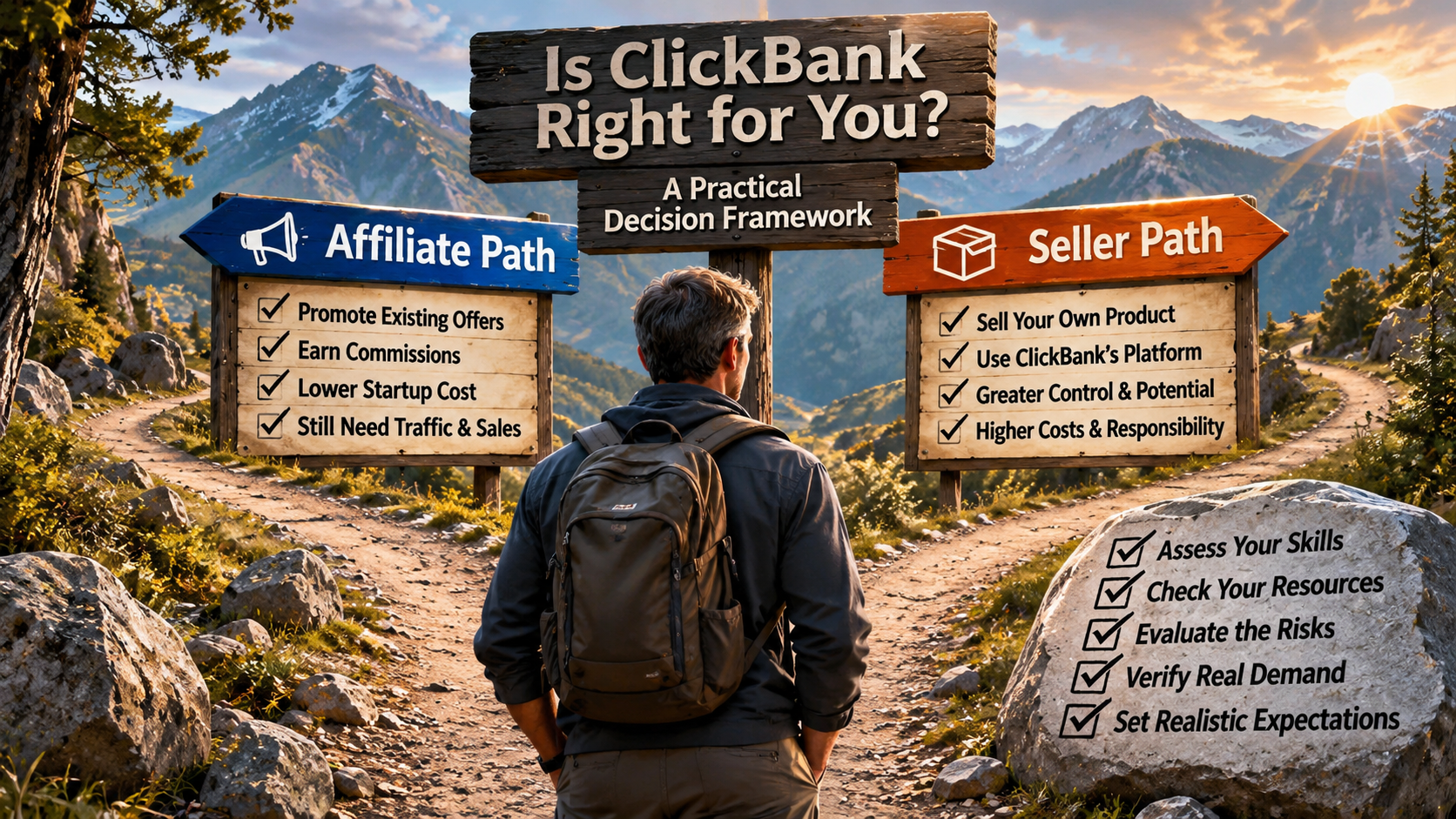
ClickBank offers two recognizable ways to participate in online commerce: promoting other businesses’ products as an affiliate or selling your own products through its platform.
Both opportunities are legitimate business models. Neither automatically becomes profitable because the platform makes participation accessible.
The question is not simply whether ClickBank works. It is whether ClickBank makes sense for you.
That answer depends on factors that an account-registration page cannot establish: your ability to reach customers, your marketing experience, available capital, time commitment, tolerance for financial uncertainty, and what you expect to achieve.
This investigation provides a practical decision framework for prospective ClickBank affiliates and sellers. Its purpose is not to encourage or discourage participation, but to help you determine whether the opportunity fits your actual circumstances.
What Does ClickBank Actually Provide?
ClickBank provides an established commerce and affiliate-marketing infrastructure. Affiliates can locate participating products, create tracking links, and receive eligible commissions when their promotions generate qualifying sales.
Sellers can use ClickBank’s checkout, transaction-processing, and affiliate-network capabilities to distribute approved products.
Those are meaningful services. They can remove certain technical and administrative obstacles associated with selling online.
However, they do not eliminate the underlying requirements of running a business.
An affiliate still needs customers willing to buy. A seller still needs a product people want, an effective offer, and sufficient revenue to cover the costs of obtaining and serving customers.
ClickBank supplies business infrastructure. It does not supply a guaranteed profitable business.
Understanding that distinction is the starting point for deciding whether participation is worthwhile.
First Decision: Affiliate or Seller?
The two participation models involve substantially different responsibilities.
| Consideration | ClickBank Affiliate | ClickBank Seller |
|---|---|---|
| What you provide | Marketing and customer referrals | Product, offer, fulfillment and customer support |
| Product creation | Generally unnecessary | Required |
| Principal challenge | Attracting buyers who convert | Creating profitable demand and delivering the product |
| Initial financial exposure | May be low with unpaid traffic; increases with advertising and tools | Product development, website, marketing and operating expenses |
| Control | Limited control over the seller’s offer and product | More control over the product, price, presentation and affiliate arrangements |
| Important dependency | Seller’s product quality, sales process and terms | Customer demand, affiliates, platform rules and operating performance |
Neither model is inherently better.
Affiliate marketing may be more practical for someone who understands a particular audience but does not want to develop products or provide customer support.
Selling may suit someone who already has a credible product, understands its customers, and can manage the responsibilities associated with operating a business.
The wrong approach is selecting either model primarily because its potential earnings look attractive.
The Five-Question ClickBank Decision Framework
Before committing significant time or money, evaluate the opportunity using five questions.
These are practical business judgments, not a statistical test that predicts success.
1. Do You Have a Realistic Way to Reach Buyers?
This is the first and arguably most consequential question.
An affiliate link does not create demand. A seller’s product listing does not guarantee sales.
Someone must reach the appropriate audience, communicate a credible reason to purchase, and persuade enough prospective customers to complete a transaction.
Ask yourself:
- Do I already reach people who might be interested in this category of products?
- If not, how exactly will I attract them?
- Do I understand the problems those customers want solved?
- Can I produce useful marketing content or obtain qualified traffic without spending more than I can afford?
- Can I explain why someone should trust my recommendation or product?
Paid advertising provides one possible route, but it requires money, testing, and a realistic understanding of acquisition costs.
Unpaid traffic can reduce immediate advertising expenses, but building an audience through content, search visibility, or social media still requires work, experience, and time.
If your entire customer-acquisition strategy amounts to posting an affiliate link and hoping people purchase, you do not yet have a business plan.
That does not necessarily mean abandoning ClickBank. It means the customer-acquisition problem must be addressed before expecting meaningful income.
2. Do You Possess the Necessary Skills—or Have a Realistic Plan to Develop Them?
ClickBank can simplify certain functions, but it cannot replace the competencies that produce profitable transactions.
Affiliates may need abilities involving audience research, product evaluation, persuasive communication, content production, advertising, tracking, and campaign analysis.
Sellers may additionally need product development, sales-page construction, fulfillment, customer service, offer testing, and management of affiliate relationships.
Not every participant needs to master every activity personally. Some tasks can be outsourced, although outsourcing introduces expenses and management responsibilities.
The essential question is whether the required work will actually be performed.
Before proceeding, identify:
- What you already know how to do.
- What you must learn.
- Which activities require outside help.
- How much time that preparation may demand.
- Whether the associated costs are manageable.
There is a substantial difference between being willing to learn and assuming you can quickly acquire specialized skills without difficulty.
A skills gap is not automatically a reason to reject ClickBank. An unrecognized skills gap is a reason to delay financial commitments.
3. Can Your Financial Position Absorb an Unsuccessful Attempt?
Potential commissions and sales are only one side of the economic equation.
The other side includes the resources consumed before, during, and after those transactions.
Affiliates may incur costs for advertising, web hosting, tools, content production, research, or outside assistance.
Sellers may incur product development expenses, platform charges, affiliate commissions, fulfillment costs, customer service expenses, and losses associated with refunded transactions.
ClickBank’s published fee structure and accounting policies also affect how and when earnings are paid.
But the most important financial question is personal:
How much can you afford to spend without receiving any return?
Determine three figures before starting:
- Your spending limit: The maximum amount you can lose without jeopardizing essential financial obligations.
- Your ongoing operating limit: The amount you can reasonably commit to a defined period of experimentation.
- Your stopping point: The financial or performance condition at which you will stop spending and reconsider the approach.
Avoid financing an unproven opportunity with money needed for living expenses or debt payments.
An initially affordable test can become financially damaging when unsuccessful experiments are repeated without a defined limit.
4. Can You Distinguish Evidence of Demand From Evidence of Profit?
A product may attract attention, record sales, or pay high commissions without being profitable for every participant promoting it.
Likewise, a seller may generate substantial gross revenue while retaining little profit after expenses.
ClickBank’s marketplace provides useful information about participating products, but marketplace indicators cannot establish your future profitability.
Before treating an offer as an opportunity, investigate:
- Whether the product addresses a credible customer need.
- Whether its sales presentation makes supportable claims.
- Whether the product’s quality justifies a recommendation.
- What you can verify about refunds, customer satisfaction and offer terms.
- Whether the likely income per sale can realistically exceed your acquisition and operating costs.
- Whether you have evidence that you can reach the customers most likely to purchase.
Suppose an affiliate expects a $40 commission on a qualifying sale.
That commission is not a $40 profit if acquiring that customer costs $45.
Even when acquisition costs are lower, refunds and other expenses may reduce the amount retained. For revenue-share commissions, refunded transactions can reverse previously credited commissions.
This is a hypothetical illustration, not evidence of typical ClickBank earnings.
For sellers, the same principle applies with additional product and operating costs.
The issue is not merely whether a sale can happen. It is whether enough profitable sales can occur consistently to justify the resources involved.
5. Are Your Time Commitment and Expectations Realistic?
Online business promotions frequently emphasize attractive outcomes. Less attention may be given to unsuccessful experiments, extended learning periods, and the effort required to establish dependable customer acquisition.
Consider what participation will realistically require from your schedule.
Can you devote consistent time to research, creating or evaluating offers, developing content, testing approaches, and reviewing results?
Can you continue learning without assuming that every week of effort must produce immediate revenue?
Can you distinguish genuine progress—such as reaching a relevant audience and improving conversion performance—from activity that merely feels productive?
Someone seeking dependable income within a few weeks faces a different decision from someone who can tolerate a long learning period and uncertain returns.
Neither circumstance is inherently unreasonable. They simply support different choices.
If you need predictable, near-term income, an unproven ClickBank venture is a poor substitute for a dependable source of earnings.
The Hidden Conditions That Could Change Your Decision
Even when the five questions appear favorable, certain platform-specific conditions deserve attention.
Earning a Commission Is Not the Same as Receiving a Payment
ClickBank applies payment thresholds and a Customer Distribution Requirement.
Under its accounting policy, an account must satisfy qualifying sales conditions before funds are released. These include at least five qualifying sales from unique customers, appropriate payment-method diversity, and applicable aging requirements.
The default payment threshold is $100, although ClickBank permits adjustments within its stated limits.
There is also a $5 processing fee for issued payments under the published standard fee schedule.
These details matter especially to participants who generate only occasional sales. A commission appearing in an account does not necessarily mean an immediate payment will follow.
Sellers Have Obligations Beyond Getting Products Approved
ClickBank sellers are responsible for developing or obtaining an eligible product, meeting applicable requirements, maintaining appropriate sales and post-purchase pages, and supporting customers.
An approved product does not guarantee buyer demand or affiliate participation.
ClickBank currently lists a $49.95 initial seller activation charge after the first product is approved. That fee may be small compared with the actual expense of developing and marketing the product.
A prospective seller should treat platform approval as permission to participate, not validation of a profitable business model.
Refunds and Compliance Can Affect Both Sides
ClickBank’s refund and accounting policies influence the amounts sellers and affiliates ultimately retain.
For standard revenue-share commissions, refunds can reverse affiliate earnings, while sellers also face transaction adjustments and refund-related costs. CPA commission arrangements can have different refund consequences.
ClickBank additionally publishes promotional guidelines restricting misleading advertising and unsupported claims.
Affiliates who endorse products for compensation must consider applicable disclosure requirements, including guidance from the U.S. Federal Trade Commission.
These are not incidental administrative details. They belong in the operating plan.
When ClickBank May Be a Reasonable Choice
ClickBank may be worth exploring when several favorable conditions are already present.
For an affiliate, these might include an identifiable audience, credible product knowledge, a workable traffic strategy, sufficient time for learning, and a willingness to measure actual results.
For a seller, they might include a tested product, demonstrable buyer demand, the capability to fulfill orders and serve customers, adequate financial reserves, and a clear reason to use ClickBank’s distribution and transaction infrastructure.
In either case, the most useful starting point is an opportunity that can be evaluated against actual evidence—not simply an attractive advertised commission or revenue figure.
There is no requirement to begin with large expenditures.
A modest, well-defined experiment may provide information about audience interest, marketing effectiveness, and practical operating requirements without exposing the participant to substantial financial loss.
However, even small experiments should have a clear purpose and predefined stopping conditions.
When You Should Probably Wait—or Choose Something Else
ClickBank may be unsuitable at present if:
- You have no identifiable audience and no workable plan to attract one.
- You need dependable income quickly.
- You would be risking money required for essential expenses.
- You are selecting products mainly because commissions appear unusually large.
- You cannot evaluate the claims or quality of the products you would promote.
- You lack the time or willingness to develop necessary skills.
- You intend to sell a product without confirming genuine demand or the ability to support customers.
- You expect ClickBank itself to provide the traffic, credibility, or business expertise you lack.
These are reasons to pause, not judgments about personal ability.
It may be more sensible to develop a marketable skill, establish an audience, validate a product, or investigate a different income model before committing to ClickBank.
The opportunity should fit your circumstances. Your circumstances should not have to be distorted to fit the opportunity.
Your Practical Go / Pause / No-Go Decision
Use the following framework before making a financial commitment.
| Decision | What it means | Appropriate next move |
|---|---|---|
| GO — Limited test | You have a credible audience or acquisition plan, relevant capabilities, an affordable spending limit, and a measurable hypothesis | Conduct a controlled experiment with clear success and stopping criteria |
| PAUSE — Preparation needed | The business model interests you, but important skills, customer evidence, or financial information are missing | Resolve the gaps before spending significantly |
| NO-GO — Current mismatch | The opportunity depends on money you cannot risk, immediate earnings you cannot afford to miss, or assumptions unsupported by evidence | Avoid committing resources and evaluate better-suited alternatives |
If You Choose GO, Define the Experiment First
Write down:
- The specific product or offer being evaluated.
- The audience you intend to reach.
- How you will reach that audience.
- Your maximum spending limit.
- The time available for the experiment.
- The results you will measure, such as qualified visitors, sales, refunds, net earnings, or acquisition costs.
- The condition that will cause you to stop, modify, or continue.
Avoid treating a single commission as proof that an entire business model works.
Equally, a small unsuccessful experiment does not establish that nobody can succeed. It establishes what happened under the conditions you tested.
Assess both the financial outcome and what the evidence actually supports.
What We Still Cannot Know
A credible decision requires acknowledging important uncertainties.
Publicly available ClickBank materials explain platform mechanisms, transaction policies, and participation requirements. They do not establish a reliable overall probability that an ordinary new affiliate or seller will earn a sustainable net profit.
Success stories cannot fill that evidence gap. They demonstrate that certain results occurred under particular circumstances, not how likely those results are for someone starting today.
Similarly, marketplace indicators and commission figures cannot establish the profitability of a participant’s individual marketing operation.
Without reliable, representative participant-outcome data, assigning a universal success percentage would be speculation.
The practical response is to evaluate personal readiness, restrict financial exposure, and measure actual results.
The Bottom Line: Is ClickBank Right for You?
ClickBank can be a useful component of an online business. Its marketplace, affiliate tracking, payment systems, and seller infrastructure provide genuine capabilities.
But platform capability should never be confused with personal opportunity.
For affiliates, the decisive question is whether they can attract customers and generate commissions that exceed the real costs of promotion.
For sellers, it is whether they can develop and support a product that generates sufficient demand and profit after platform charges, commissions, refunds, and operating expenses.
For both, the decision depends on skills, time, available resources, and the ability to tolerate uncertain outcomes.
ClickBank may be worth testing when those conditions are understood, reasonably favorable, and financially manageable. It is not a sound commitment when participation depends primarily on attractive earnings claims and optimistic assumptions.
The strongest decision is not necessarily to join or walk away.
It is to know what must be true for participation to make sense—and to establish that evidence before making a substantial commitment.
Continue Your ClickBank Investigation
Before reaching a final decision, examine the underlying research across the ClickBank Investigation Library.
For the affiliate perspective, read:
- Why ClickBank Affiliates Earn Nothing: The Reality Behind the Opportunity — Why access to offers does not automatically produce earnings.
- The True Economics of ClickBank Affiliate Marketing: Costs, Break-Even, and Profit — How expenses affect the financial outcome.
- Choosing ClickBank Offers: What to Verify Before You Promote — The evidence that matters when evaluating products.
For the seller perspective, read:
- Becoming a ClickBank Seller: Requirements, Costs, and Realities — What participation demands before a product can be sold.
- ClickBank Seller Economics: What Remains After Fees, Affiliates, and Refunds — What sellers may retain after transaction and operating costs.
For the wider promotional picture, read:
- The Hidden Requirements Behind ClickBank Income Claims — Why advertised earnings and actual participant outcomes can be very different.
Return to the ClickBank Investigation Library to explore all twelve investigations.
Research reviewed: November 6, 2026. ClickBank policies, charges, and operating requirements can change. Verify current terms before committing funds.