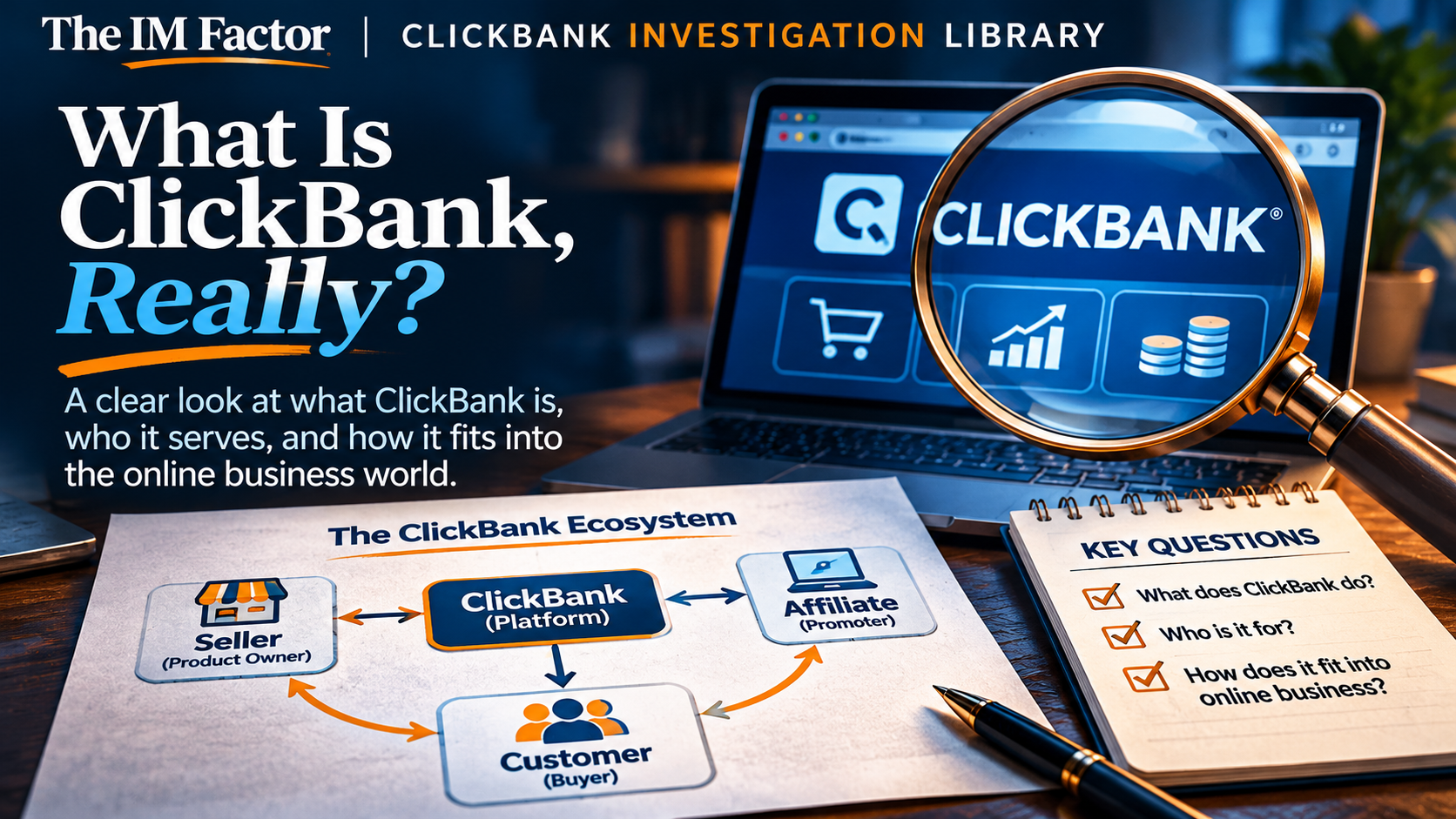
ClickBank is an established e-commerce platform that connects product sellers with affiliate marketers and provides the infrastructure for processing sales, tracking referrals, and distributing payments.
That sounds like an attractive opportunity for someone interested in earning money online.
But there’s an important distinction between what ClickBank provides and what a participant must accomplish to earn a profit.
Understanding that distinction is where our investigation begins.
What Is ClickBank’s Actual Business Model?
ClickBank operates a commercial system connecting four participants:
| Participant | Primary role |
|---|---|
| Product seller | Creates or supplies a product, develops its offer, and determines its affiliate commission arrangements |
| Affiliate | Promotes a seller’s offer and attempts to generate qualifying purchases |
| Customer | Purchases the product or service |
| ClickBank | Provides the transaction, tracking, affiliate-management, and payment infrastructure |
ClickBank supports both digital and physical products. Its model is particularly associated with direct-response marketing, where promotional material encourages prospective customers to take a specific purchasing action.
An important detail is how ClickBank participates in a transaction.
Under its standard accounting model, ClickBank purchases the product from the seller at a wholesale price and resells it to the customer. It manages the relevant transaction and payment arrangements rather than simply introducing a buyer to a seller.
ClickBank’s standard transaction fee is 7.5% plus $1, although particular transaction types and payment arrangements can differ.
This matters because ClickBank operates a revenue-generating commercial infrastructure. It is not merely a free directory of products people can promote.
What Does ClickBank Offer an Affiliate?
From the affiliate’s perspective, ClickBank removes several significant operational barriers.
An affiliate does not ordinarily need to develop the product, build the seller’s checkout infrastructure, or personally calculate and distribute commissions.
Instead, the affiliate can:
- Open a ClickBank account without a signup fee.
- Search the Marketplace for products and promotional opportunities.
- Review certain offer statistics and commission information.
- Obtain an affiliate tracking link for an eligible offer.
- Promote that offer through permitted marketing channels.
- Receive commissions when qualifying purchases are successfully attributed to the affiliate, subject to the applicable terms.
Some sellers require approval before allowing an affiliate to promote their offers.
These are genuine advantages. ClickBank provides access to commercial infrastructure that would otherwise be difficult or costly for an individual to reproduce.
But access to that infrastructure does not include a guaranteed supply of customers.
The affiliate remains responsible for finding prospective buyers and convincing them to consider an offer.
That responsibility is much larger than obtaining a tracking link.
The Difference Between Joining ClickBank and Building an Affiliate Business
This is where the tip-of-the-iceberg problem begins.
The visible opportunity is straightforward: promote a product and potentially earn a commission.
The larger business requirements are less straightforward.
| What ClickBank provides | What the affiliate must still accomplish |
|---|---|
| Access to participating sellers and offers | Identify a suitable market and credible products |
| Affiliate tracking technology | Attract prospective buyers through effective promotion |
| Commission arrangements | Generate sufficient qualifying sales |
| Marketplace performance statistics | Determine whether those statistics are relevant to the affiliate’s own circumstances |
| Transaction and payment infrastructure | Manage marketing expenses, risks, and financial performance |
The distinction is crucial.
A person might possess everything required to operate a ClickBank affiliate account yet lack the audience, promotional expertise, traffic volume, or resources needed to build a profitable business.
The platform can be functioning exactly as designed while the participant earns nothing.
That does not automatically establish that ClickBank is defective or that the participant has failed through lack of effort.
It means the two activities—participating in a platform and operating a commercially viable business—are fundamentally different.
Who Makes Money, and Under What Conditions?
Each participant has a different economic position.
ClickBank receives compensation from qualifying sales processed through its system.
The seller receives proceeds according to the applicable transaction and commission arrangements, while remaining responsible for important aspects of the product and offer.
The affiliate earns commissions from qualifying purchases, subject to the applicable commission structure and payment rules.
The customer receives the purchased product or service.
But these arrangements do not establish that every participant in a transaction earns a profit.
An affiliate may earn a commission while spending more on advertising, software, content production, and customer acquisition than the commission generates.
A seller may generate revenue while facing substantial production, fulfillment, promotional, and operational expenses.
And an affiliate who never produces a sale may earn nothing—even after investing considerable time and money.
This is a central economic reality:
A functioning affiliate transaction system does not guarantee a profitable outcome for the people using it.
It is equally important not to claim that ClickBank earns transaction fees from unsuccessful promotions that produce no sales. Its standard transaction-based revenue model depends on completed transactions, not merely on affiliates attempting to promote offers.
The interests of the platform, seller, and affiliate can overlap without their financial outcomes being identical.
What Does ClickBank’s Own Data Reveal?
Two figures published by ClickBank are particularly revealing.
91% Earned Less Than $10,000
In an article discussing affiliate earnings, ClickBank reported that its 2023 analysis found 91% of affiliates who made at least one sale earned less than $10,000 on the platform.
That is a significant finding, but we must examine its limits.
First, the figure excludes people who never made a sale.
Second, the published statement does not clearly establish the precise earnings period represented by the $10,000 figure.
Third, the figure concerns platform earnings, not independently verified net profit after promotional expenses.
It therefore cannot tell us what percentage of all ClickBank account holders ultimately operate profitable businesses.
An Average of 570 Days to a First Paycheck
ClickBank has also reported an average of 570 days between affiliate account creation and receipt of a first paycheck.
That is approximately nineteen months.
However, the statement does not establish how much time those affiliates spent actively promoting offers. It also does not tell us how many account holders never received a paycheck.
An average calculated around successful payment recipients cannot establish the probability that a new affiliate will ever be paid.
What Remains Unknown
These figures demonstrate why participant statistics require careful interpretation.
We still need credible answers to questions such as:
How many people open ClickBank affiliate accounts but never make a sale? How many receive commissions but fail to recover their promotional expenses? How many become consistently profitable? How much capital and time do typical participants invest?
Without reliable information about those outcomes, we cannot responsibly calculate an ordinary participant’s probability of financial success.
Those unanswered questions are not evidence of misconduct. They are important limitations on what publicly presented earnings figures can establish.
Our dedicated investigation into affiliate earnings and participant outcomes will examine the available evidence more deeply.
What Else Must a Participant Understand?
ClickBank’s infrastructure does not eliminate the broader responsibilities of operating an online business.
Customer acquisition: The affiliate needs a way to reach people with a genuine interest in the promoted offer. Organic traffic, paid advertising, email, and other channels have different costs, skills, and requirements.
Product evaluation: A commission percentage does not establish product quality, customer satisfaction, or the likelihood of profitable conversions.
Payment conditions: Receiving a commission and receiving a cash payout are not always simultaneous. ClickBank has payment thresholds and a Customer Distribution Requirement, among other payment rules.
Marketing compliance: Affiliates remain responsible for complying with applicable advertising requirements. In the United States, the Federal Trade Commission generally expects material affiliate relationships to be disclosed clearly when endorsements are involved.
Financial accountability: A commercially responsible affiliate must track expenses and results independently. Commission reports alone do not establish actual business profit.
None of these considerations makes ClickBank inherently unsuitable.
They establish that successful use requires substantially more than access to the platform.
Who Is ClickBank Actually Suitable For?
ClickBank can be useful for an affiliate who already understands an audience, can evaluate products, and has a realistic method of acquiring customers.
It can also be useful for sellers with suitable products, effective offers, and the resources to manage the responsibilities of a commercial operation.
For beginners, it may provide a practical environment for learning about affiliate marketing.
But the platform should not be confused with a complete business strategy, a guaranteed income opportunity, or a substitute for market knowledge and sound financial decisions.
People considering participation should evaluate the resources they possess, the costs they can tolerate, the capabilities they need to develop, and the evidence supporting their assumptions.
The Bottom Line
ClickBank is a legitimate commercial infrastructure for connecting sellers, affiliates, and customers. Its core services solve real operational problems, including referral tracking, transaction processing, and commission administration.
What it does not solve automatically is the participant’s business problem: finding customers, generating sufficient sales, controlling costs, and achieving a sustainable profit.
That’s the distinction too often lost when an opportunity is reduced to the simplicity of joining a platform and promoting a product.
ClickBank provides access to an opportunity. It does not establish the likelihood of a profitable outcome for the individual pursuing it.
Understanding that difference is the first step toward evaluating the full iceberg.
Continue Your ClickBank Investigation
Next: How ClickBank Actually Works
A closer examination of the relationships between sellers, affiliates, customers, and ClickBank—and how those relationships shape the business.
Return to: ClickBank Investigation Library
Navigation destinations will be activated when the corresponding investigations and hub are published.
Research Sources
- ClickBank — How ClickBank Works
- ClickBank — What Is the Marketplace?
- ClickBank — How Affiliates Earn Commissions
- ClickBank — Fees
- ClickBank — Accounting Policy
- ClickBank — Affiliate Marketing 101
- ClickBank — How to Make Money with ClickBank
- FTC — Endorsement Guides: What People Are Asking
Research reviewed: November 1, 2026.
Independent editorial analysis. The IM Factor is not affiliated with ClickBank.